The independent guide to China, in 13 languages
Plan China from the guidebook,not from guesswork.
Every place on this site comes from China Self Guided Travel 2025, with tickets, opening hours, transport and the page it was printed on. Read it in your language, then turn it into a day by day itinerary.
Free. No account needed to plan; sign in only to save and share.
1,880 places · 154 cities · 34 provinces · 13 languages

Featured · Guangxi
Li River
The scenery of the entire Li River can only be described as poetic and picturesque.
Li River, Guangxi · AI illustration for China Trip

Huangshan (Yellow Mountain)
Covering 154 square kilometres, the Mount Huangshan scenic area is world-famous for its “Four Wonders”: dramatically twisted pines, strangely shaped granite peaks, sea-of-clouds views, and hot springs. A local saying goes: “Without visiting Wenshu Courtyard (Yuping Tower), you haven't seen Huangshan's true face; without reaching Tiandu Peak, your trip is wasted; without Guangming Summit, you haven't seen Huangshan's scenery; without Lion Peak, you haven't found Huangshan's trail; without Shixin Peak, you haven't seen Huangshan's pines.”
Huangshan (Yellow Mountain), Anhui

Mogao Caves
Located 25 km southeast of Dunhuang city, on the southern side of Mingsha Mountain, the Mogao Caves are China’s largest cave complex. Their finest treasures are the murals and painted sculptures, created from the Former Qin dynasty through the Sui and Tang, making them a treasure of Chinese art. In 1900, the Daoist monk Wang Yuanlu discovered the Library Cave, which held nearly 60,000 historical artefacts, including Buddhist scriptures in various scripts, historical records, letters, literary works and social documents, making it a treasure trove for the study of Chinese history from the 4th to the 11th century. Unfortunately, social upheaval in the late Qing and early Republican periods led to large numbers of these materials being taken away by foreigners, and fewer than one-third of the Library Cave artefacts remain in China. Today there are 492 caves, containing 2,415 painted sculptures and 45,000 square metres of murals. The Nine-Storey Pavilion is the emblem of the Mogao Caves; it houses a 34-metre Tang-dynasty Buddha made of clay over a stone core, which, together with another 26-metre Buddha, is known as the Northern and Southern Great Buddhas.
Dunhuang, Gansu
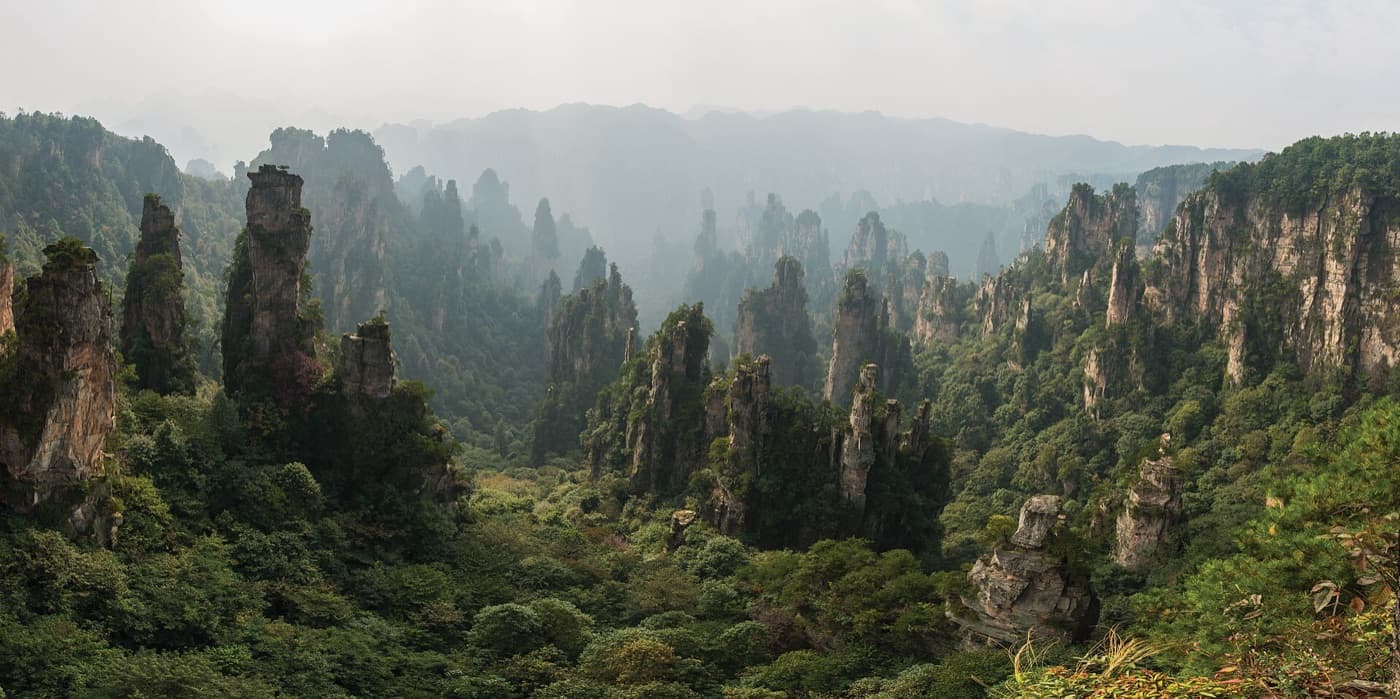
Zhangjiajie National Forest Park
Zhangjiajie National Forest Park, also known as Qingyan Mountain, is as famous as Jiuzhaigou and was China's first national forest park. Its forests are home to precious tree species such as dove trees, ginkgoes and tulip trees, and rare animals including macaques and giant salamanders. Together, its unusual peaks and rock formations, mountain springs and waterfalls, deep forests and rare trees, and its rare birds and beasts form a natural landscape rarely seen anywhere in the world. The national forest park includes scenic areas such as Huangshi Stockade, Golden Whip Stream, Yaozi Stockade, Shadao Gully and Pipa Stream, with more than 100 attractions in total. Zhangjiajie uses fingerprint IC card electronic tickets. The national forest park operates a single-ticket system. The four-day pass allows entry to Yangjiajie, Tianzi Mountain, Golden Whip Stream, Huangshi Stockade and Yuanjiajie. Golden Whip Stream: The stream runs 7.5 km from Laomowan to Shuirao Simen. It takes about 2.5 hours and must be explored on foot. Stone pillars and towering peaks line both banks, and pools and waterfalls are everywhere. Ancient trees, rare flowers and wildlife thrive side by side. Main sights include Welcome Rock, Golden Whip Rock, Purple Grass Pool, Thousand-Mile Reunion and Shuirao Simen. Huangshi Stockade: Huangshi Stockade is the largest viewing platform in the park, with panoramic views over the entire forest park. Highlights include Heavenly Book Casket, Sea-Stabilising Needle, Single Pillar to the Heavens, Front Garden and Golden Turtle Searching the Sea. To climb Huangshi Stockade, you can hike up from the park's front gate or take the Huangshi Stockade cable car directly to the summit. Yuanjiajie: Yuanjiajie lies in the northwest corner of the forest park. Main sights include the World's First Bridge, Lost Soul Terrace, Heavenly White Silk Waterfall, Hallelujah Mountain, Back Garden and Sky Farmland. You can reach Yuanjiajie by sightseeing lift from Shuirao Simen, or on foot from Tianzi Mountain or Golden Whip Stream. Yaozi Stockade: This route comes second only to Huangshi Stockade. The terrain is steep, with cliffs and deep valleys on all sides, making it a favourite with thrill-seekers. The summit is an open platform said to have been where villagers hid from bandits during the Republican era. Today it is an excellent viewing point. Bailong Elevator: The Bailong Elevator has been entered in the Guinness World Records for being the world's tallest, fastest and highest-capacity elevator. While riding, you can look through the glass at one of Zhangjiajie's great sights: the Divine Soldiers Gathering, a cluster of dozens of relatively independent stone peaks directly opposite the elevator.
Zhangjiajie, Hunan
What you get
Built for the part of a China trip that is hard from abroad: the practical facts.
Know before you go
Tickets, hours, time needed and how to get there for each place, so nothing is a surprise at the gate.
Book the way China books
Which attractions need real name advance booking, and which apps and mini programs to use for trains, tickets and payments.
A route in minutes
Tell us your days and cities. We lay out sights, meals and where to sleep from the guidebook’s own itineraries and ratings.
Read it in your language
Thirteen languages, with the Chinese name beside every place so you can show it to a driver or a ticket desk.
Check anything
Each entry keeps its guidebook page number, and every page has a plain text version you can save for offline reading.
Destinations by region
Seven regions, 34 provinces. Start with the one that fits your season and your pace.

Beijing
Beijing Municipality · 57 places · 6 day itinerary
Hundreds of years ago, Beijing was built to embody the highest ideals of imperial rule. Today, the north-south central axis and the strictly symmetrical east-west layout of the city have grown somewhat blurred, yet traces of the ideal of harmony between heaven and humanity can still be sensed. As a former imperial capital, the city was far more concerned with expressing moral ideals and moral instruction than with providing a comfortable place to live. Even now, Beijing has not become China's most liveable city. It may not be a comfortable place to live, but it is often a place for ideas. Among all Chinese cities today, Beijing is arguably the one where idealists are most concentrated. In fact, people in this city are happy to see themselves as idealists, yet most of them also have a clear-eyed, even shrewd sense of reality. Of course, in Beijing today, idealism can be a banner, a slogan, a genuine way of acting or a nostalgic mood; it can be a stance of rejecting the worship of money, or it can become a sign for making a profit or a pretext for... Whatever the case, at least in this city, people still remember that the word "idealism" exists.

Shanghai
Shanghai Municipality · 42 places · 4 day itinerary
They say Shanghai's most fascinating quality is how “old meets new.” As for “new,” Pudong Airport, the Oriental Pearl Tower and the Maglev train all represent the country's latest and fastest. As for “old,” it does not mean that Shanghai has a long history. Counting from when it first appeared as a small fishing village, it has only about six or seven centuries behind it before becoming an international metropolis. The “old” refers to the glamour of old Shanghai, the city of the Ten-Mile Foreign Concessions, from its shikumen (stone-gate) lanes to its former foreign concessions. The opulent, dazzling music of that era still seems to drift faintly in the air.

Chengdu
Sichuan Province · 46 places · 4 day itinerary
At the “Talking About the Fourth City” forum, hosted by New Weekly magazine and others, Chengdu beat Shenzhen to become the fourth city after Beijing, Shanghai and Guangzhou. The city has a full range of industries and a distinctive Sichuan cultural tradition, along with famous food, drink and beautiful women. In recent years, more and more outsiders have come to love Chengdu. Descriptions such as “the city you won't want to leave” and “the Eastern Garden of Eden” keep multiplying, and their content boils down to “laid-back, content with small comforts, mahjong and hotpot.” In reality, local housing prices have pushed most people beyond the Third Ring Road. Chengdu is no longer just a pastoral idyll, and the typical Chengdu comfort and ease seem to be losing some of their footing, inevitably tinged with Chinese-style anxiety. Yet no matter which direction you head from Chengdu, within 100 kilometres you will still find traditional, remote mountain villages, where tens of millions of Sichuan farmers work hard all year round and form the famous army of migrant labourers. Chengdu, which accounts for nearly a third of Sichuan's economic output, has every advantage of location and resources, drawing on the best of the province's resources, and it is the whole province that has nurtured it.

Xi'an
Shaanxi Province · 15 places · 2 day itinerary
If every city had a gender, Xi'an would be the most masculine of them all. Its massive city walls, grey-yellow tones and the deep imperial aura of an ancient capital leave no room for anything delicate. Locals eat from enormous bowls, and the occasional strains of Qinqiang opera (秦腔) carry a rugged, weathered masculinity.
How it works
Tell us how long you have and where you want to go.
Tell us how many days you have; we lay out the days, the sights, the meals and where to sleep.
Build a free itinerary01
Choose your days and cities
Pick how long you have and where you want to go, or let the guide choose a classic route.
02
Get a day by day plan
Sights with timings, lunch and dinner, and where to stay, drawn from the guidebook’s quick itineraries.
03
Save, adjust and share
Shuffle, move stops between days, add notes, then share a link with the people travelling with you.
Before you go
Entry rules, payments, apps, trains and booking, written for visitors from abroad.
Entry, visas and registration
Who can enter without a visa, the 240 hour transit rule, Tibet permits and the hotel registration everyone must do.
When to go and which weeks to avoid
Seasons by region, the three holiday weeks when the whole country travels, and what the weather does to your plan.
Paying for things
How to set up Alipay and WeChat Pay with your home card, when you still need cash, and why there is no tipping.
Phone, internet and the apps you need
Which of your apps stop working in China, how to get data, and the six apps that replace them.
Trains, flights, metro and taxis
How to book high speed trains, get through the station, ride the metro with your phone and hail a taxi that understands you.
Booking attractions
Why the Forbidden City sells out a week ahead, how real name booking works, and which sights you must reserve.
The five star index

Stone Forest Scenic Area
Kunming, Yunnan Province
Stone Forest boasts the most extraordinary karst landscape in the world, attracting countless visitors from China and abroad, and is hailed as the “First Wonder Under Heaven”. “Scenery of Stone Forest” is the most representative attraction here. Within the scenic area are “animal-shaped” rocks such as Tang Monk Rock, Monkey King Rock and Ashima, each with its own beautiful legend.

Jiuxiang Scenic Area
Kunming, Yunnan Province
Jiuxiang Scenic Area is famous for its karst caves and is known as the “Land of Caves”. The cave system formed from ancient dolomite some 600 million years old. Inside are nine major areas, including Jinghun Gorge, Yincui Gorge, Guhe Cave, Shennü Palace and Yijia Village. Jinghun Gorge is the largest gorge inside a cave in China, and Yincui Gorge is known as the “Lovers' Valley”, where young Yi men and women of Jiuxiang once sang love songs to each other. The area has also served as a filming location for several films, including *The Myth* and *Little Big Soldier*.
- Stone Forest Scenic AreaKunming
- Jiuxiang Scenic AreaKunming
- Dali Ancient TownDali
- Cangshan–Erhai National Nature ReserveDali
- Lijiang Old TownLijiang
- Mu ResidenceLijiang
- Shuhe Ancient TownLijiang
- Lugu Three IslandsLugu Lake
- BingzhongluoNujiang (Salween River)
- Tengchong Volcano and Hot Sea (Rehai)Tengchong
- Heshun Ancient TownTengchong
- Xishuangbanna Primeval Forest ParkXishuangbanna
By region
Questions before you start
Is China Trip free?
Yes. Browsing, searching and building an itinerary need no account. You only sign in, with email or Google, to save trips and places.
Where does the information come from?
From the 2025 edition of China Self Guided Travel (《中国自助游》, Tianjin Science & Technology Press, August 2024), parsed page by page. Every entry keeps its page number.
Are prices and opening hours current?
They are printed as they appear in the August 2024 edition, in Chinese yuan. Hours, tickets and transport change often in China, so confirm with the venue’s official WeChat mini program or ticket office before you go.
Do I need to book attractions in advance?
Many major attractions now require real name advance booking, often through a WeChat or Alipay mini program. The travel guides section explains which apps to use.
Which languages are available?
English, Simplified and Traditional Chinese, Japanese, Korean, German, French, Spanish, Italian, Thai, Vietnamese, Indonesian and Malay. Translations follow the Chinese edition; names and prices stay as printed.
How does the itinerary builder work?
You choose days, cities, pace and interests. The builder arranges the guidebook’s own quick itineraries and ratings into a day by day plan with sights, meals and stays, which you can shuffle and then save.
Can I share a trip?
Yes. A saved trip can be made public with one link that anyone can open. You can make it private again at any time.
Can I use it offline?
Each place and city page has a plain text version that you can save or print before you travel.
Is China Trip connected to the publisher or to attractions?
No. China Trip is independent and is not affiliated with the publisher or with any attraction. Contact: [email protected].
What data do you store?
Only your email address or Google account identifier when you sign in, and the trips and saved places you create. There are no advertising trackers.
Start with the number of days you have.
The itinerary builder lays out sights, meals and stays from the guidebook. Adjust it, then share it.
Free. No account needed to plan; sign in only to save and share.