Zhangjiajie travel guide
张家界
Zhangjiajie travel guide with a day by day itinerary, 6 places with tickets and opening hours, where to eat and stay, and how to get there.
6 places · In the guidebook: pages 1955–1967

Zhangjiajie, Hunan Province · AI illustration for China Trip
Quick itinerary
Zhangjiajie in 3 days
- Day 1
- Yuanjiajie→
- Yangjiajie→
- Tianzi Mountain
- Day 2
- Ten-Mile Gallery→
- Jinbian Stream→
- Zhangjiajie Grand Canyon
- Day 3
The feel of the place
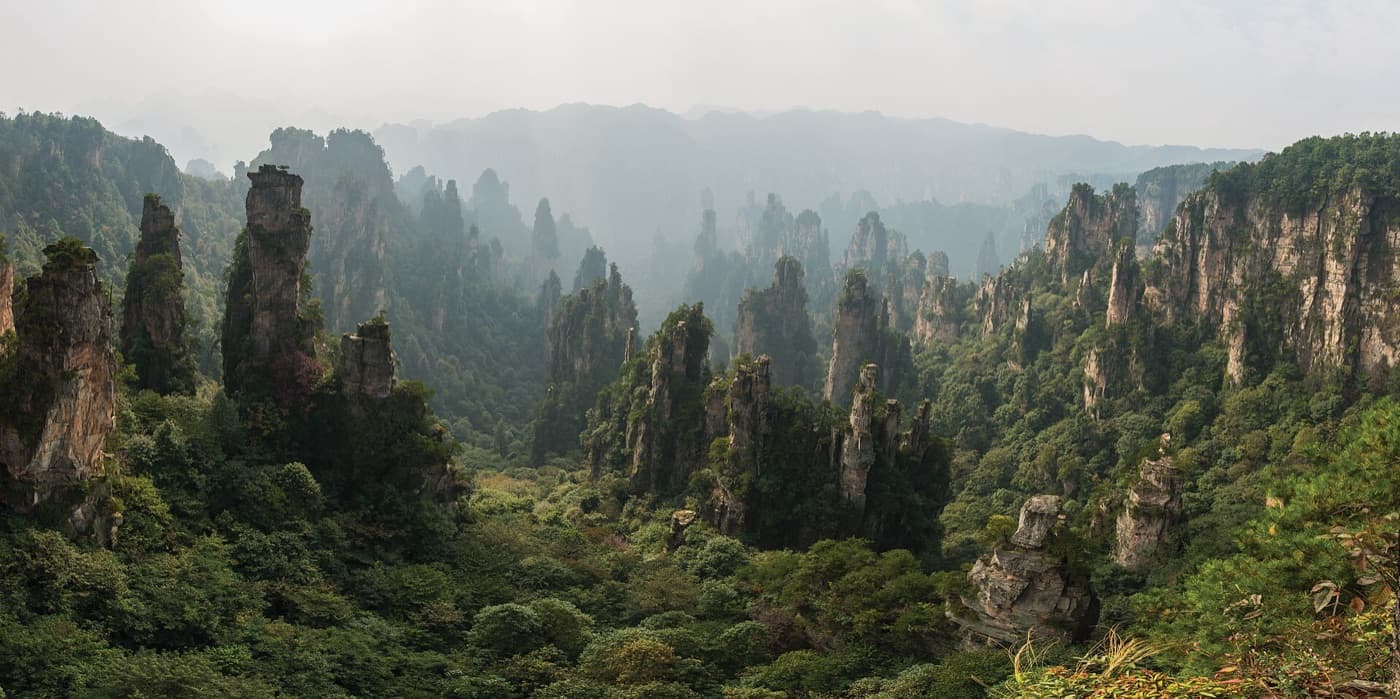
Jiuzhaigou is for water, Zhangjiajie is for mountains. Indeed, nowhere else in the world will you find scenery like this: three thousand strange peaks rising from the earth and eight hundred streams winding through them. Here it is hailed as “a magnified bonsai garden, a miniature wonderland”, “a utopia” and “the original of Chinese landscape painting”. Every beautiful word has been used to describe it, yet none can fully capture the visual shock it brings.
Preparation and Enquiries
Language
If locals speak their dialect a little more slowly, it is easier to understand. Speaking Mandarin usually works fine when communicating with local people.
Climate and Travel Season
The best times to visit Zhangjiajie are April and October, when its natural scenery is at its most beautiful. Avoid climbing on rainy days: the paths become slippery, and the mountaintops are often shrouded in fog, making the views hard to see. The best time to go up is within one to two hours after the rain stops, when the landscape is most striking.
Things to see
Riding the Bailong Elevator makes it easier to reach sights such as the Tianxia Diyi Bridge (First Natural Bridge Under Heaven), Mihuntai, Wulongzhai and Yangjiajie.
Zhangjiajie National Forest Park
1–4 days · ¥65 one-way
Zhangjiajie National Forest Park, also known as Qingyan Mountain, is as famous as Jiuzhaigou and was China's first national forest park. Its forests are home to precious tree species such as dove trees, ginkgoes and tulip trees, and rare animals including macaques and giant salamanders. Together, its unusual peaks and rock formations, mountain springs and waterfalls, deep forests and rare trees, and its rare birds and beasts form a natural landscape rarely seen anywhere in the world. The national forest park includes scenic areas such as Huangshi Stockade, Golden Whip Stream, Yaozi Stockade, Shadao Gully and Pipa Stream, with more than 100 attractions in total. Zhangjiajie uses fingerprint IC card electronic tickets. The national forest park operates a single-ticket system. The four-day pass allows entry to Yangjiajie, Tianzi Mountain, Golden Whip Stream, Huangshi Stockade and Yuanjiajie. Golden Whip Stream: The stream runs 7.5 km from Laomowan to Shuirao Simen. It takes about 2.5 hours and must be explored on foot. Stone pillars and towering peaks line both banks, and pools and waterfalls are everywhere. Ancient trees, rare flowers and wildlife thrive side by side. Main sights include Welcome Rock, Golden Whip Rock, Purple Grass Pool, Thousand-Mile Reunion and Shuirao Simen. Huangshi Stockade: Huangshi Stockade is the largest viewing platform in the park, with panoramic views over the entire forest park. Highlights include Heavenly Book Casket, Sea-Stabilising Needle, Single Pillar to the Heavens, Front Garden and Golden Turtle Searching the Sea. To climb Huangshi Stockade, you can hike up from the park's front gate or take the Huangshi Stockade cable car directly to the summit. Yuanjiajie: Yuanjiajie lies in the northwest corner of the forest park. Main sights include the World's First Bridge, Lost Soul Terrace, Heavenly White Silk Waterfall, Hallelujah Mountain, Back Garden and Sky Farmland. You can reach Yuanjiajie by sightseeing lift from Shuirao Simen, or on foot from Tianzi Mountain or Golden Whip Stream. Yaozi Stockade: This route comes second only to Huangshi Stockade. The terrain is steep, with cliffs and deep valleys on all sides, making it a favourite with thrill-seekers. The summit is an open platform said to have been where villagers hid from bandits during the Republican era. Today it is an excellent viewing point. Bailong Elevator: The Bailong Elevator has been entered in the Guinness World Records for being the world's tallest, fastest and highest-capacity elevator. While riding, you can look through the glass at one of Zhangjiajie's great sights: the Divine Soldiers Gathering, a cluster of dozens of relatively independent stone peaks directly opposite the elevator.

Tianzi Mountain Scenic Area
3–4 hours · Zhangjiajie Pass
Tianzi Mountain is known as the 'King of Peak Forests'. Its landscape is extraordinary and thrilling, distinguished by its tall, large and numerous peaks. The mountain takes its name from Xiang Dakun, a Tujia leader who once proclaimed himself 'Son of Heaven' here.

Suoxiyu Scenic Area
Suoxiyu is a transliteration from the Tujia language meaning 'mountain village of thick fog'. Eight smaller scenic areas have been developed, including West Sea, Ten-Li Gallery, Shuirao Simen, Huanglong Cave, Baizhang Gorge and Baofeng Lake. Ten-Li Gallery: Ten-Li Gallery offers a scene at every step, with paintings everywhere you look. Main sights include Longevity Star Greeting Guests, The Herb-Gathering Old Man and Fairy Worshipping Guanyin. Along more than ten li of valley, rich natural scenery lines both sides, and walking through it feels like being inside a painting. Huanglong Cave and Baofeng Lake: Huanglong Cave is a must-visit. You will not find another cave with such unique geology, complex structure, vast scale and rich formations. Baofeng Lake, known as the 'Jade Pool of Heaven', is another essential stop. West Sea: The greatest highlight of West Sea is its white clouds. After rain clears, the forest, peak and cloud 'seas' merge into one spectacular view. Tongtian Gate and Terrace are the best viewing points.
Mountains & Adventure · Nature

Tianmen Mountain
Tianmen Mountain is the highest peak in Zhangjiajie and takes its name from the natural wonder Tianmen Cave (Heavenly Gate Cave). It is the earliest mountain in Zhangjiajie to be recorded in history, located 10 km south of Zhangjiajie city centre. Known in ancient times as Yunmeng Mountain, it is also called Yuping Mountain, and is divided into four scenic areas: Tianmen Cave Opening, Heavenly Realm Buddhist Kingdom, Emerald Field Jade Terrace, and Immortal Wonderland. In 263 CE, a collapse of the cliff face opened a gateway through the upper part of the mountain, linking north and south. The Wu king Sun Xiu of the Three Kingdoms period considered this auspicious and named it 'Tianmen Mountain' (Heavenly Gate Mountain). Tianmen Cave: Tianmen Cave sits on a cliff face more than 1,260 metres above sea level. Opening north and south through a sheer wall, it is an imposing and towering high-altitude cave, a rare example of a mountain-piercing karst cave. Tianmen Mountain Cable Car: The cable car runs for 7,455 metres, making it one of the longest high-mountain passenger cable cars in the world. It departs from City Garden in central Zhangjiajie and carries passengers straight up to the primeval 'sky garden' on the summit. Like a rainbow spanning the human world and the heavens, the ride offers a thrilling sensation of soaring through the air.
0.5–1 day · Zhangjiajie Tianmen Mountain: Scenic Pass ¥278 (includes admission to Tianmen Cave and the summit area, round-trip Tianmen Mountain cable car, and eco-shuttle transport); Tianmen Cave Tour Ticket ¥235 (includes scenic area admission and eco-shuttle transport); Summit Tour Ticket ¥225 (includes scenic area admission and round-trip cable car)
Yangjiajie Scenic Area
Yangjiajie combines the features of Zhangjiajie and Tianzi Mountain. Though less well known than the other two, it is equally worth a visit. Yangjiajie is a recently developed scenic area in the northwest of Zhangjiajie, north of Tianzi Mountain. It spans Zhonghu Township at the western end of Wulingyuan District and consists of three smaller areas: Xiangzhi Stream, Longquan Gorge and Baihou Valley. The total area covers about 34 square kilometres, and its highlights alone number over 200. World's No. 1 Wonder Waterfall: Yangjiajie's most famous feature is Longquan Falls, known as the 'World's No. 1 Wonder Waterfall'. Other interesting spots include One-Step Ascent to Heaven, Sky Corridor, Cliff Vine King and Gathering of White Cranes. Tujia Mountain Songs: Many places in the scenic area offer mountain songs for 10 yuan per performance. The Mountain Song Pavilion in Wulong Village is considered the best place to listen. The Tujia women here seem to have especially clear voices, and the echoes in the empty valley make it an authentic experience of traditional Tujia mountain songs. Flora and Fauna Park: Yangjiajie is rich in plant and animal life. Over a thousand macaques roam the cliffs and gullies, tens of thousands of egrets gather at White Crane Flat, and unusual five-coloured flowers and night-blooming jasmine are found throughout the mountains. Yang Family Legacy: Local legend holds that the Yang family living here are descendants of the famous Yang Family Generals of the Northern Song dynasty. They still preserve the Yang Family Genealogy and several Yang family ancestral tombs.
Gardens & Flowers · Photography · Wildlife · Nature
Zhangjiajie Grand Canyon
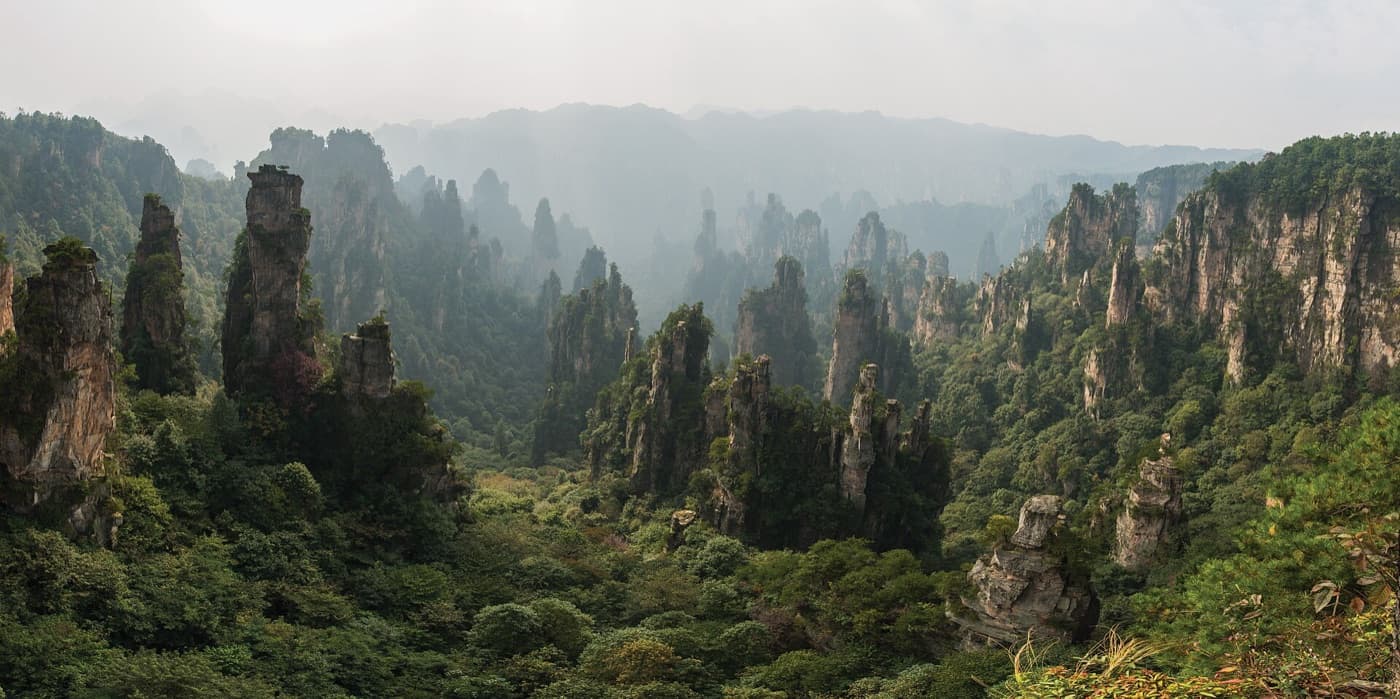
Zhangjiajie Grand Canyon is located in Cili County, Zhangjiajie City. Its gorge is lush with vegetation, and cascading waterfalls and mountain streams are found everywhere. The scenic area also features the Zhangjiajie Grand Canyon Glass Bridge, one of the highest and longest glass bridges in the world, offering sweeping views down into the valley.
3–4 hours · ¥128
Getting there & around
Getting There and Around
By Air
Zhangjiajie Hehua Airport is located in Hehua Village, Guanliping Office, Yongding District, Zhangjiajie City. It currently operates flights to more than 20 cities across China. The airport is only 5 km from downtown Zhangjiajie.
Airport shuttle bus: usually stops at the airport exit. The journey takes about 10 to 20 minutes, and the fare to the Airport Hotel (机场大酒店) in the city centre is ¥5.
Bus: Route 4. Fare ¥1–2. The journey takes about half an hour.
Taxi: About ¥15–20 to the city centre in the daytime and around ¥30 at night. Going directly to the scenic areas is more expensive, at around ¥100.
Note on Flights
Apart from Shanghai, Beijing, Guangzhou, Tianjin, Chengdu, Changsha, Xi'an, Qingdao, Shenyang, Xiamen, Hangzhou and Nanjing, flights to other cities do not operate every day. Travellers should check flight schedules carefully in advance.
By Train
Zhangjiajie Railway Station has passenger train services to more than 20 major and mid-sized cities across China. Direct trains run to cities such as Beijing, Shanghai and Guangzhou. Trains to Guangzhou, Changsha and Zhanjiang start from Zhangjiajie, so they are convenient to board.
Since the railway station moved to the South Station in 2007, bus routes 5, 6, 13 and 101 run from the station into the city. From the bus station, minibuses to the scenic areas cost ¥12 to Forest Park and ¥12 to Wulingyuan, departing every 10 minutes.
Intercity high-speed trains run from Changsha to Zhangjiajie more than ten times a day. The journey takes 2–3 hours, and tickets cost ¥130–166.
tip: After exiting the South Station, you will walk straight into the station square, where many salespeople will try to sell you multi-day tour packages. To avoid hassle, walk directly to the large square on the left of the exit and catch your transport from there without engaging with them.
By Road
Getting Around Locally
Local transport here mainly refers to transport within the scenic areas. Zhangjiajie Railway Station is 33 km from the Zhangjiajie scenic areas.
Minibus
Minibuses run daily between the railway station in Zhangjiajie city and the scenic areas. The fare is ¥10 and the journey takes one hour.
Cable Cars
Wulingyuan Tianzishan cable car: ¥72 one way, ¥144 return. Huangshizhai cable car: ¥65 one way, ¥130 return. Where there is no cable car, you can rent a sedan chair. Bailong Elevator: ¥65 one way, ¥130 return.
Bus Station
By RoadLocated at the intersection of Huilong Road and Renmin Road in the city centre. It has long-distance buses to major cities within and outside the province, as well as short-distance buses to nearby scenic areas and neighbouring counties and cities.
- Phone:
- 0744-8305599
- Taking long-distance buses from this area is usually not a good choice. The region is mountainous, with winding, hard-to-navigate roads, so the journey is slow and costly.
Eat & drink
Food and drink in Zhangjiajie city is relatively cheap, with street stalls on nearly every corner serving mainly Tujia-style dishes. Inside the scenic areas, however, dining is much more expensive: a vegetable dish costs at least ¥15, and any dish with meat is ¥30 or more. It is advisable not to eat wild game, which is prohibited by law.
Signature Flavours
Tujia cuisine includes cured meats, blood tofu, reunion-dinner dishes, shefan (festival rice), and deep-fried bee brood. Tujia hotpot and Tujia snacks are inexpensive yet delicious. In Zhangjiajie you can also enjoy sweet, juicy corn on the cob and wild kiwifruit, which are hard to find in big cities.
At mountain villagers' homes you have the chance to taste genuinely authentic cured pork, which city versions simply cannot match. Prices need not worry you either: the higher the mountain, the fewer the visitors, and the cheaper the food.
Tujia cuisine also features dried foods, such as dried green beans and dried potatoes, which are tasty and make good gifts to take home.
Recommended Specialty Dishes
Hu Shifu Sanxiaguo (Bus Station Branch)
Recommended Specialty DishesSanxiaguo is a dry pot, a hotpot that is simmered without any broth. A local signature dish, it braises dry-fried pork intestines and dry-fried walnut meat together. The portions are generous, and three people can share two servings. Add an order of sour radish, which is crisp, tangy and very good.
- Address:
- Behind the bus station, Guanli Road
- Phone:
- 13317443333
Where to stay
Accommodation in Zhangjiajie is mainly concentrated in three areas: Suoxiyu, the city centre and the Forest Park.
Suoxiyu
Located in the centre of many attractions, including Tianzi Mountain, Huanglong Cave and Baofeng Lake, it offers very convenient transport to each site, and hotels of every grade are available.
City Centre
Close to the railway station and airport but far from the scenic areas, with both upscale star-rated hotels and budget inns.
Forest Park
Most hotels inside the scenic area have been demolished, leaving only a few farmhouse inns (nongjiale). Since the entrance ticket is valid for only two days, staying inside the scenic area is especially useful for visitors planning to spend more than two days here, though the facilities are not as good as those outside. During the Golden Week holiday, rooms are in short supply, so book in advance. Farmhouse inns are mainly concentrated in three areas: Yangjiajie, Yuanjiajie and Tianzi Mountain. There are many hotels at the entrance to the scenic area, which suit visitors who only plan to visit the Forest Park.
Shopping
Kiwifruit, Qingyan Mingcui tea, lobster tea and pine mushrooms are all local specialties, affordable and good value. Sangzhi salted tofu, gegen (kudzu root) drinks, Maoping Maojian tea and Tujia-style cured meats are also worth buying.
Zhangjiajie's kiwifruit is sweet and juicy. If you want to take some home, it is best to buy unripe ones, as ripe kiwifruit bruises and spoils easily. Tujia handicrafts are sold at the folk museum east of Puguang Temple, and if you're lucky, you may find one or two pieces you love.
Nightlife
The Tujia Maogusi dance, Tujia Baishou dance, Tujia hard-qigong martial arts, Tujia brocade weaving and Tujia Yang opera all retain distinctive ethnic characteristics to this day. Local theatres and cultural centres host many spectacular ethnic performances. If you happen to visit during a festival, you can join your local ethnic brothers and sisters in singing and dancing to your heart's content.
Source: China Self-Guided Travel 2025 (《中国自助游》, Tianjin Science & Technology Press, Aug 2024), pp. 1955–1967. Translated from the Chinese edition; names and prices follow the guidebook. · Plain text version