Thousand Islands Rapeseed Flower Scenic Area
Here, the rapeseed fields are cut into block-like shapes by the river, like slices of cake on a jade-green table, irresistibly sweet. Pole a sculling boat through the golden fields,…
Thousand Islands Rapeseed Flower Scenic Area, Yangzhou
Key facts
- Admission
- ¥50 (boat ticket + ¥100 admission)
- Opening hours
- 8:00—17:00
- Time needed
- 2–4 hours
- Getting there
- Direct buses run from Yangzhou to Xinghua City. From there, transfer to a shuttle to Gugu, which takes you to the scenic area.
- Guidebook rating
- 4 / 5
From China Self Guided Travel 2025, page 1104. Open in Google Maps
About Thousand Islands Rapeseed Flower Scenic Area
Here, the rapeseed fields are cut into block-like shapes by the river, like slices of cake on a jade-green table, irresistibly sweet. Pole a sculling boat through the golden fields, feel the gentle breeze, and drift with the ripples as the water’s liveliness and the flowers’ vitality surround you. Every worry is sure to fade away.
Frequently asked questions
How much does Thousand Islands Rapeseed Flower Scenic Area cost?
Admission to Thousand Islands Rapeseed Flower Scenic Area is ¥50 (boat ticket + ¥100 admission), as listed in the 2025 guidebook. Prices can change; check the official channel before you go.
What are the opening hours of Thousand Islands Rapeseed Flower Scenic Area?
Thousand Islands Rapeseed Flower Scenic Area is open 8:00—17:00.
How do I get to Thousand Islands Rapeseed Flower Scenic Area?
Direct buses run from Yangzhou to Xinghua City. From there, transfer to a shuttle to Gugu, which takes you to the scenic area.
How long should I spend at Thousand Islands Rapeseed Flower Scenic Area?
Plan on 2–4 hours for Thousand Islands Rapeseed Flower Scenic Area.
Where is Thousand Islands Rapeseed Flower Scenic Area?
Thousand Islands Rapeseed Flower Scenic Area is in Yangzhou, Jiangsu Province, in the East China of China. East of Dongwang Village, Gugu Township, Xinghua City, Taizhou
More places in Yangzhou

Heyuan Garden
As you enter, the scenery may look familiar. Nearly a hundred film and TV productions, including *A Dream of Red Mansions*, *My Fair Princess* and *Heaven Has Tears*, have filmed here. He Garden is considered a representative work of late-Qing garden design in Yangzhou. It is known for its covered corridors, which wind through the grounds, with paths that lead you deeper into the garden and stone bridges with railings overlooking the water. The architecture and craftsmanship reward close attention. The garden also holds genuine calligraphy and paintings by Han Qi, Su Shi, Tang Yin, Zheng Xie and Liu Yong, well worth a careful look.
¥45 in peak season; ¥30 in off-season · 1–2 hours

Geyuan Garden
Geyuan Garden is one of Yangzhou’s most renowned gardens. It was built during the Jiaqing and Daoguang reigns of the Qing dynasty by Huang Zhiyun, the salt merchant in charge of the Huaihe salt trade, on the former site of the Ming-era Shouzhi Garden. Unlike other gardens famed for their rockwork, Geyuan is celebrated for its bamboo and stone, and bamboo is planted throughout. Even the garden’s name draws on the “ge” character, which is half of the character for “bamboo” (竹), echoing the varieties of bamboo in the courtyards. The owner’s taste and intellect are woven into every detail.
¥45 in peak season; ¥30 in off-season · 1–2 hours
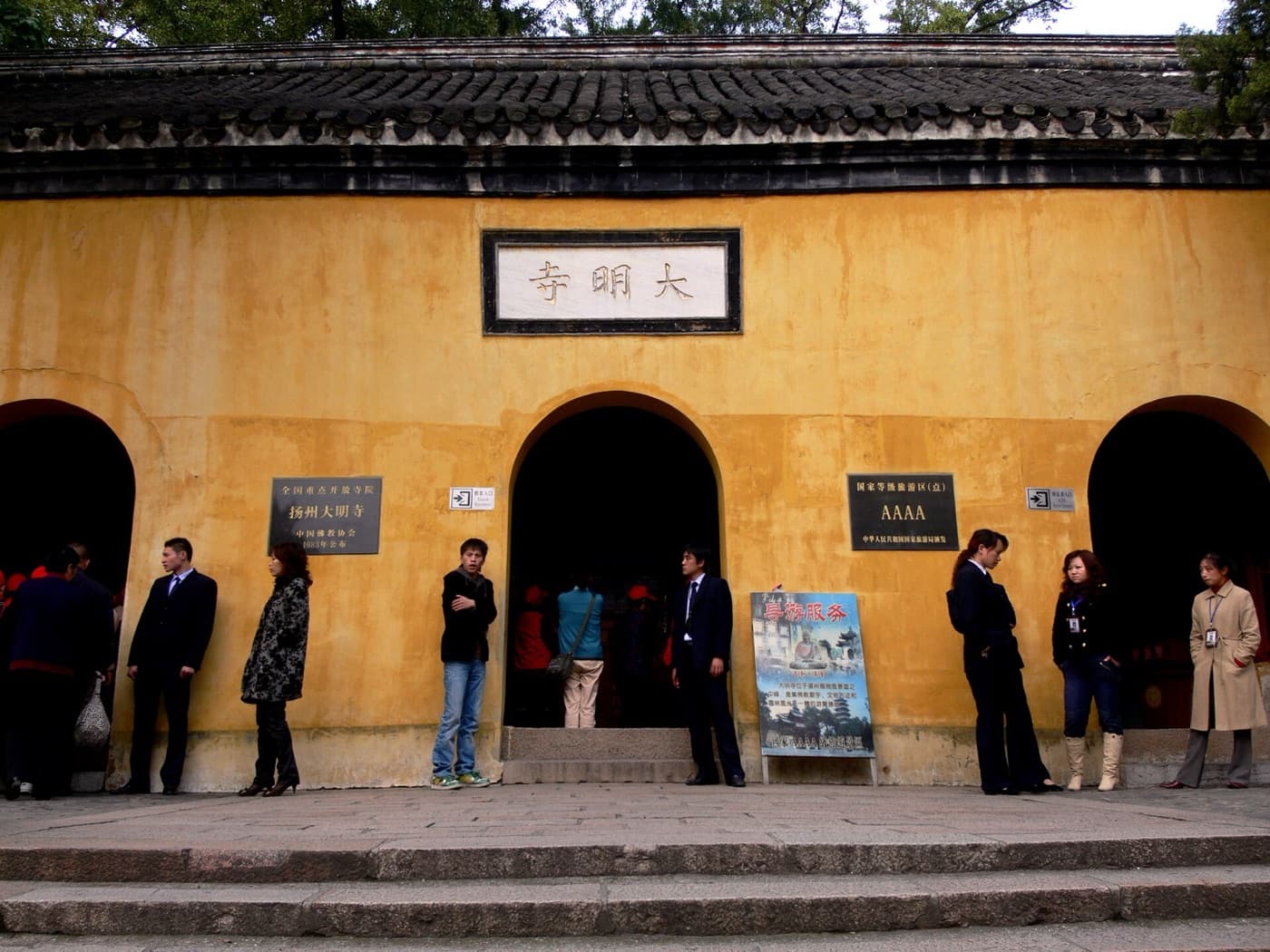
Daming Temple
Daming Temple sits against the hills and beside the water. With its long history and beautiful setting, it combines a Buddhist temple, historic relics and garden scenery into a religious tourist destination. Over the centuries, Daming Temple has been home to many eminent monks. Emperors, sages, literati and refined scholars have gathered here, and visitors linger in admiration while devout pilgrims pray for good fortune, happiness and long life.
Off-season ¥30; peak season ¥45; pagoda climb plus bell-striking ¥25 · 1–2 hours
Yangzhou Historic Residences
Lu Family Residence: The largest luxury residence of the late-Qing Yangzhou salt merchants, it is known as the “No. 1 Building of the Salt Merchants.” The Lu Residence holds five “mosts”: the widest site, the grandest gateways, the most halls, the most spacious reception rooms and the longest construction period. Wang Family Courtyard: One of the most completely preserved large salt-merchant residences in Yangzhou from the late Qing and early Republic period. Its balanced layout of interconnected courtyards, with inner and outer sections fitting together naturally, is one of the traditional patterns of Yangzhou’s grand mansions. The compact garden is full of exquisite carvings. Wu Daotai Residence: One of the three great mansions of Jiangnan, it blends Jiangnan and Western styles. The most notable feature is the Cehai Tower, a library modeled on Tianyi Pavilion in Ningbo. At its height, it held 240,000 volumes, but sadly most have since been lost.
Eight Eccentrics of Yangzhou Memorial Hall
The English word “ugly” used in the sense of the Chinese term “chou ba guai” (丑八怪, literally “ugly eight eccentrics”) has its roots in the eight Yangzhou painters of the Qing dynasty. Their lasting influence on Chinese culture makes the Eight Eccentrics of Yangzhou Memorial Hall the best classroom for understanding them.
¥24 · 1–3 hours
Slender West Lake
A natural waterway whose slender surface, likened by poets to a maiden swaying in the breeze, earned it the name “Slender West Lake.” Visitors have flocked to it for centuries, drawn by the single word “slender.” Jiangnan landscapes are usually shaped by human hands, so opinions on them often differ. Whatever your view, no trip to Yangzhou is complete without seeing Slender West Lake.
¥100 · 3–5 hours