Yangzhou travel guide
扬州
“Of the world's moonlit nights, two parts belong to Yangzhou's charming scoundrels”: this single line of poetry drew emperors, ministers and literati in ancient times, and it remains the most evocative slogan today.…
12 places · In the guidebook: pages 1089–1105

Yangzhou, Jiangsu Province · AI illustration for China Trip
Quick itinerary
Yangzhou in 2 days
- Day 1
- Day 2
- Geyuan Garden→
- Heyuan Garden→
- Lane Wandering (the streets near Ge Garden and He Garden have many old residences and former homes of famous figures; plan your route according to your interests)→
- Guandong Street (dinner)
The feel of the place
- Ordinary Lanes and Alleys
- “Of the world's moonlit nights, two parts belong to Yangzhou's charming scoundrels”: this single line of poetry drew emperors, ministers and literati in ancient times, and it remains the most evocative slogan today. The song-and-dance glamour of the old pleasure quarters has long faded. Though “Yangzhou in the third month of flowering mist” is the famous image, the most captivating thing is still the ordinary lanes and alleys of its streets. For a few yuan, hire a pedicab and glide through the lanes that interweave like blood vessels, and Yangzhou's past and present rush at you all at once.
- Leisurely Living
- “Morning, skin around water (tea in the teahouse); evening, water around skin (the bathhouse)” vividly captures daily life in Yangzhou: morning tea and evening bathhouse visits are the two most important events of the day. Though both are leisurely lifestyles, Yangzhou differs greatly from Chengdu. Yangzhou people enjoy their comfort quietly, reservedly and refinedly, whereas Chengdu is much more boisterous.
- Beauties of Yangzhou
- “Since ancient times Yangzhou has produced beauties,” so people have always linked the city with beautiful women. In fact, the Jiangnan region has produced not only scholars but also beauties, though not necessarily only in Yangzhou city. The water and misty air of Jiangnan are such that women from anywhere, after just a week here, find their skin turning fine and moist. It is hard not to become beautiful.
The Beautiful Wangyue Lake
Wangyue Lake lies in the hilly country northwest of Yangzhou's urban area. Its scenery is beautiful, and it is the original home of China's Yuhua stones (rain-flower stones). Winter is a good season for birdwatching by the lake, when migratory birds such as wild geese, swans and mandarin ducks winter here. Bring a high-powered telescope if you can; the birds gather in their hundreds and thousands, quite a spectacle.
Shorter Journey via Zhenjiang
Trains between Shanghai and Yangzhou have to detour via Nanjing and take a long time, so visitors coming from Shanghai, Suzhou and other directions may prefer to take a train to Zhenjiang first and then transfer to a bus to Yangzhou, which shortens the trip.
Pedicabs Are a Good Choice
Pedicabs are inexpensive, and riding in one lets you take in the streetscapes at a leisurely pace. In a city like Yangzhou, the pedicab is a very pleasant way to get around.
Preparation and Information
Language
The Yangzhou dialect belongs to the Huai group of Chinese dialects, but Mandarin is understood just as well here.
Climate and Best Time to Visit
Yangzhou has distinct four seasons, with an annual average temperature of 14.8℃, and winter is relatively long. April and May are the best months to visit. As the classic line “Yangzhou in the third month of flowering mist” attests, this is when the Qionghua (Yangzhou viburnum) blooms. Yangzhou's Qionghua differs from the common herbaceous Qionghua: its flowers form round, snowball-like clusters, glistening white and intensely fragrant.
Things to see
One route enters through the north gate on Yanfu East Road, visiting the gardens first and then the residences; this is the standard route. The other enters through the south gate on Dongguan Street, visiting the residences first and then the gardens; this is the newer route.

Geyuan Garden
1–2 hours · ¥45 in peak season; ¥30 in off-season
Geyuan Garden is one of Yangzhou’s most renowned gardens. It was built during the Jiaqing and Daoguang reigns of the Qing dynasty by Huang Zhiyun, the salt merchant in charge of the Huaihe salt trade, on the former site of the Ming-era Shouzhi Garden. Unlike other gardens famed for their rockwork, Geyuan is celebrated for its bamboo and stone, and bamboo is planted throughout. Even the garden’s name draws on the “ge” character, which is half of the character for “bamboo” (竹), echoing the varieties of bamboo in the courtyards. The owner’s taste and intellect are woven into every detail.

Heyuan Garden
1–2 hours · ¥45 in peak season; ¥30 in off-season
As you enter, the scenery may look familiar. Nearly a hundred film and TV productions, including *A Dream of Red Mansions*, *My Fair Princess* and *Heaven Has Tears*, have filmed here. He Garden is considered a representative work of late-Qing garden design in Yangzhou. It is known for its covered corridors, which wind through the grounds, with paths that lead you deeper into the garden and stone bridges with railings overlooking the water. The architecture and craftsmanship reward close attention. The garden also holds genuine calligraphy and paintings by Han Qi, Su Shi, Tang Yin, Zheng Xie and Liu Yong, well worth a careful look.
Wenchang Pavilion
Wenchang Pavilion was built during the Wanli reign of the Ming dynasty as the Kuixing Tower of the Yangzhou Prefectural School, which is how it came to be called “Wenchang Pavilion.” From the top, you can take in the street scenes near and far. On festival nights, colored lanterns light up the tower and the streets below, making it one of the most scenic spots in downtown Yangzhou.
1 hour · Free
Slender West Lake
A natural waterway whose slender surface, likened by poets to a maiden swaying in the breeze, earned it the name “Slender West Lake.” Visitors have flocked to it for centuries, drawn by the single word “slender.” Jiangnan landscapes are usually shaped by human hands, so opinions on them often differ. Whatever your view, no trip to Yangzhou is complete without seeing Slender West Lake.
3–5 hours · ¥100
Eight Eccentrics of Yangzhou Memorial Hall
The English word “ugly” used in the sense of the Chinese term “chou ba guai” (丑八怪, literally “ugly eight eccentrics”) has its roots in the eight Yangzhou painters of the Qing dynasty. Their lasting influence on Chinese culture makes the Eight Eccentrics of Yangzhou Memorial Hall the best classroom for understanding them.
1–3 hours · ¥24
Yangzhou Historic Residences
Lu Family Residence: The largest luxury residence of the late-Qing Yangzhou salt merchants, it is known as the “No. 1 Building of the Salt Merchants.” The Lu Residence holds five “mosts”: the widest site, the grandest gateways, the most halls, the most spacious reception rooms and the longest construction period. Wang Family Courtyard: One of the most completely preserved large salt-merchant residences in Yangzhou from the late Qing and early Republic period. Its balanced layout of interconnected courtyards, with inner and outer sections fitting together naturally, is one of the traditional patterns of Yangzhou’s grand mansions. The compact garden is full of exquisite carvings. Wu Daotai Residence: One of the three great mansions of Jiangnan, it blends Jiangnan and Western styles. The most notable feature is the Cehai Tower, a library modeled on Tianyi Pavilion in Ningbo. At its height, it held 240,000 volumes, but sadly most have since been lost.
History & Culture · Architecture
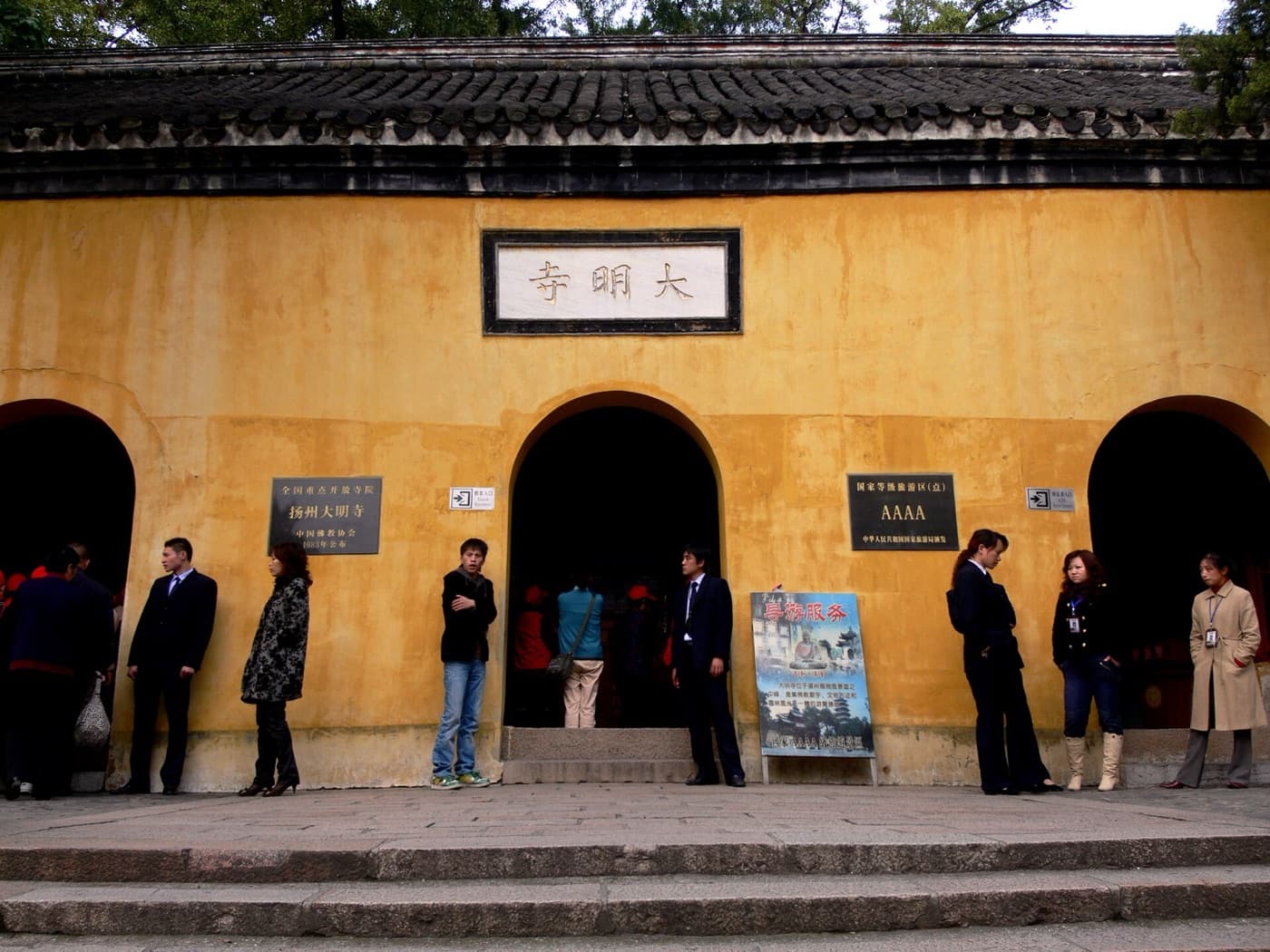
Daming Temple
Daming Temple sits against the hills and beside the water. With its long history and beautiful setting, it combines a Buddhist temple, historic relics and garden scenery into a religious tourist destination. Over the centuries, Daming Temple has been home to many eminent monks. Emperors, sages, literati and refined scholars have gathered here, and visitors linger in admiration while devout pilgrims pray for good fortune, happiness and long life.
1–2 hours · Off-season ¥30; peak season ¥45; pagoda climb plus bell-striking ¥25
Yangzhou Dongguan Street
Dongguan Street is the most representative historic street in Yangzhou. Its old shops, the stone archway in the south of the city, Huaju Lane and the China Paper-cut Museum all have their own character. Start by sampling Yangzhou’s local specialties. Follow the crowds to find the most popular stalls; Jianhu lotus root starch dumplings are a must-try here. For shopping, the street is full of small shops, and some century-old brands are among them. Xie Fuchun Duck Egg Powder, for example, is recommended in many guides as a “must-buy souvenir from Yangzhou” and is especially popular with women.
1–3 hours
Zhu Ziqing Former Residence
The former residence of Zhu Ziqing dates back to the Qing dynasty. The plaque above the doorway reading “Former Residence of Zhu Ziqing” was inscribed by Jiang Zemin. The two guest rooms on the right were Zhu Ziqing’s study and bedroom. The rooms display his personal belongings, including bookcases, a pipe and writing implements. Zhu Ziqing lived in many places across China, but this Yangzhou home is the best preserved of the Zhu family’s former residences.
1–2 hours · Free
Yangzhou Grand Canal
The waters of the Yangzhou section of the Grand Canal are clear, and its banks are lined with famous sights and distinctive local customs. When night falls, a stroll along the embankment is delightful, with lights twinkling across the water. From the end of the old Dongguan Street, you can reach the canal.
1 hour · Free (boat ticket ¥80)
Getting there & around
Getting In and Out
Well-developed waterways link Yangzhou northward to Beijing, up to Shanghai, and down to Wuhan and Chongqing. Of course, road transport is also the main way Yangzhou connects with the outside world.
Self-driving visitors from Shanghai can take the Shanghai–Nanjing Expressway, passing Kunshan and Suzhou, then switch to the Beijing–Shanghai Expressway after Wuxi. Exit at the Yangzhou exit, pass the Zhuanqiao toll station, then leave the expressway at the Yangzhou East signposted junction to enter the city. Shanghai to Yangzhou is 290 km.
By Air
Flights from Yangzhou Taizhou Airport serve cities including Beijing, Shenyang, Dalian, Harbin, Xiamen, Shenzhen, Guangzhou, Sanya, Changsha, Chengdu, Kunming and Xi'an.
Buses and city buses run between the airport and the city. A direct trip from downtown Yangzhou to the airport takes only 45 minutes.
phone: 0514-89999999
Trains and High-Speed Rail
Passengers can take high-speed rail to Zhenjiang station. On leaving the railway station, walk 50 metres to the right to reach the bus station, where buses to Yangzhou run about every 10 minutes on average. It is quick and convenient.
In addition, Yangzhou Railway Station has direct express trains to Beijing, and express trains direct to Xi'an, Guangzhou, Hankou and Shanghai. Several other trains departing from Shaanxi, Henan, Hubei, Hunan, Guangdong, Anhui, Jiangxi, Jiangsu and Shanghai also pass through Yangzhou.
By Road
Minibuses run several times a day between Nanjing Bus Station and Yangzhou, and there are also coaches to and from Wuxi and Zhenjiang. Between Zhenjiang and Yangzhou, shuttle buses run every 10–15 minutes, with a journey time of 45–50 minutes.
Shanghai Coach Terminal, Pudong Coach Station and Hutai Road Coach Station all run buses to Yangzhou, with fares of ¥70–102.
Getting Around the City
Buses
For visitors, tourist bus lines and sightseeing buses stop at major sights such as Slender West Lake, Daming Temple, He Garden, Ge Garden and Dongguan Ancient Ferry, making them a good bus option. Wenchang Pavilion in the city centre is where bus routes are most densely concentrated, and they reach almost every part of the city. If you cannot find a bus that goes directly to your destination, change at Wenchang Pavilion. Yangzhou and Zhenjiang are separated by just a river and are very close, and intercity buses now connect the two cities.
Taxis
Flag fall is ¥10 for the first 3 km; ¥1.80 per km for 3–16 km; ¥2 per km beyond 16 km. During statutory public holidays, a surcharge of ¥5 per trip is added on top of the flag fall.
Boats and Ferries
Car ferries run between Guazhou Ferry Terminal in Yangzhou and Zhenjiang, and they also carry pedestrians. Take a bus from Yangzhou West Bus Station to reach the terminal. The ferry fare is ¥3 per person, and the crossing to Zhenjiang takes about 10 minutes.
Railway Station
Trains and High-Speed Rail- Phone:
- 0514-85546222
Eat & drink
Yangzhou cuisine, part of the Huaiyang culinary tradition, is renowned far and wide, so be sure to sample authentic Yangzhou flavours when you visit.
Yangzhou Pickles
Yangzhou pickled vegetables have a long history and are well known across the Jiangsu and Zhejiang region. They are prized for their fresh, sweet and crisp flavour, and are one of the signature foods of Yangzhou. They make a great gift to take home.
Fuchun Teahouse
Where to EatA great place for morning tea. Signature dishes include hot dried tofu shreds, shrimp and Fuchun steamed buns.
- Address:
- No. 35 Desheng Bridge Street
- Phone:
- 0514-87233326
- Fuchun Teahouse has opened a branch. If you take a taxi there, be sure to tell the driver you want the original shop first. Otherwise, because the roads to the branch are easier to drive, drivers will often default to 'the branch'.
Xiaojuelin Vegetarian Restaurant
Where to EatA well-known old restaurant. Its vegetarian dishes are tasty, generously portioned and good value. The best dishes include bean curd skin soup, stir-fried 'pork liver', vegetarian 'large intestine', crispy rice crust, sweet and sour wheat gluten, and fragrant, crispy twisted dough sticks.
- Address:
- No. 298 Guangling Road, Guangling District
- Phone:
- 0514-87221179
Where to stay
Yangzhou Changle Inn
Where to StayA hotel converted from an old Ming and Qing dynasty house with a great location. The Garden of Master of Nets (Ge Yuan) is a short walk away, and you can easily visit the Xie Fuchun shop and the Wang Family Residence on the way. Fuchun Teahouse is also very close.
- Address:
- No. 357 Dongguan Street, Guangling District
- Phone:
- 0514-87993333/87807986
- ¥
- Standard room ¥626
Home Inn Express (Slender West Lake Branch)
Where to StayBeside Slender West Lake, with attentive service and a pleasant environment.
- Address:
- No. 15 Niansi Bridge Road, Yangzhou
- Phone:
- 0514-87317222
- ¥
- Standard room ¥170
Shopping
Jade and lacquerware are известные as the two specialties of Yangzhou, making them excellent souvenirs.
Yangzhou's busiest shopping street is Wenchang Road, which has many large shopping centres such as Wanjiafu, Jinying International and Baisheng Commercial Building. Wenhe Road and Guoqing Road are also major shopping streets.
Nightlife
Recommended Night Tours
Yechun Teahouse is one of the best places to enjoy the night views. Located inside Yechun Garden beside the outer moat, it is right next to the Imperial Wharf, the starting point of the Qianlong water tour route, where you can take a boat to Slender West Lake. Sitting by the window at night and looking out at the scenery reflected in the lake and framed by green willows is quiet and elegant. Yangzhou is known as the 'Moon City of China', and famous lines of poetry such as 'Thousands of lanterns in the night market light up the blue clouds' vividly describe the beauty of Yangzhou after dark. On holidays and during festivals, Slender West Lake, He Garden and other scenic spots often host evening tours.
Jiankanghai Bathhouse Plaza
Recommended Night ToursApart from the Qionghua flower, Yangzhou is famous for its 'Three Knives' (the haircut scissors, foot-care knife and kitchen knife). Soaking in a bath here and then having your feet cared for is a real treat.
- Address:
- No. 450-8 Guoqing Road
- Phone:
- 0514-87359568
Day trips & beyond
Thousand Islands Rapeseed Flower Scenic Area
Here, the rapeseed fields are cut into block-like shapes by the river, like slices of cake on a jade-green table, irresistibly sweet. Pole a sculling boat through the golden fields, feel the gentle breeze, and drift with the ripples as the water’s liveliness and the flowers’ vitality surround you. Every worry is sure to fade away.
2–4 hours
Tianning Temple
Tianning Chan Temple was first built during the Zhenguan era of the Tang dynasty, more than 1,300 years ago. Tianning Temple is also an ancient temple of Jiangnan celebrated in a poem by Xu Zhimo. Its incense is lively, drawing visitors from across the country to burn incense and pray for blessings. The temple’s Tianning Pagoda offers a view over the whole city of Changzhou from the top, and the Treasure Hall on the east and west sides is well worth a visit.
1–2 hours
Source: China Self-Guided Travel 2025 (《中国自助游》, Tianjin Science & Technology Press, Aug 2024), pp. 1089–1105. Translated from the Chinese edition; names and prices follow the guidebook. · Plain text version