Jianmen Pass
‘The road to Shu is harder than climbing to the heavens’: this line from Li Bai captures the perils of the Shu Road, and only by standing at Jianmen Pass can you truly grasp the commanding force of i…
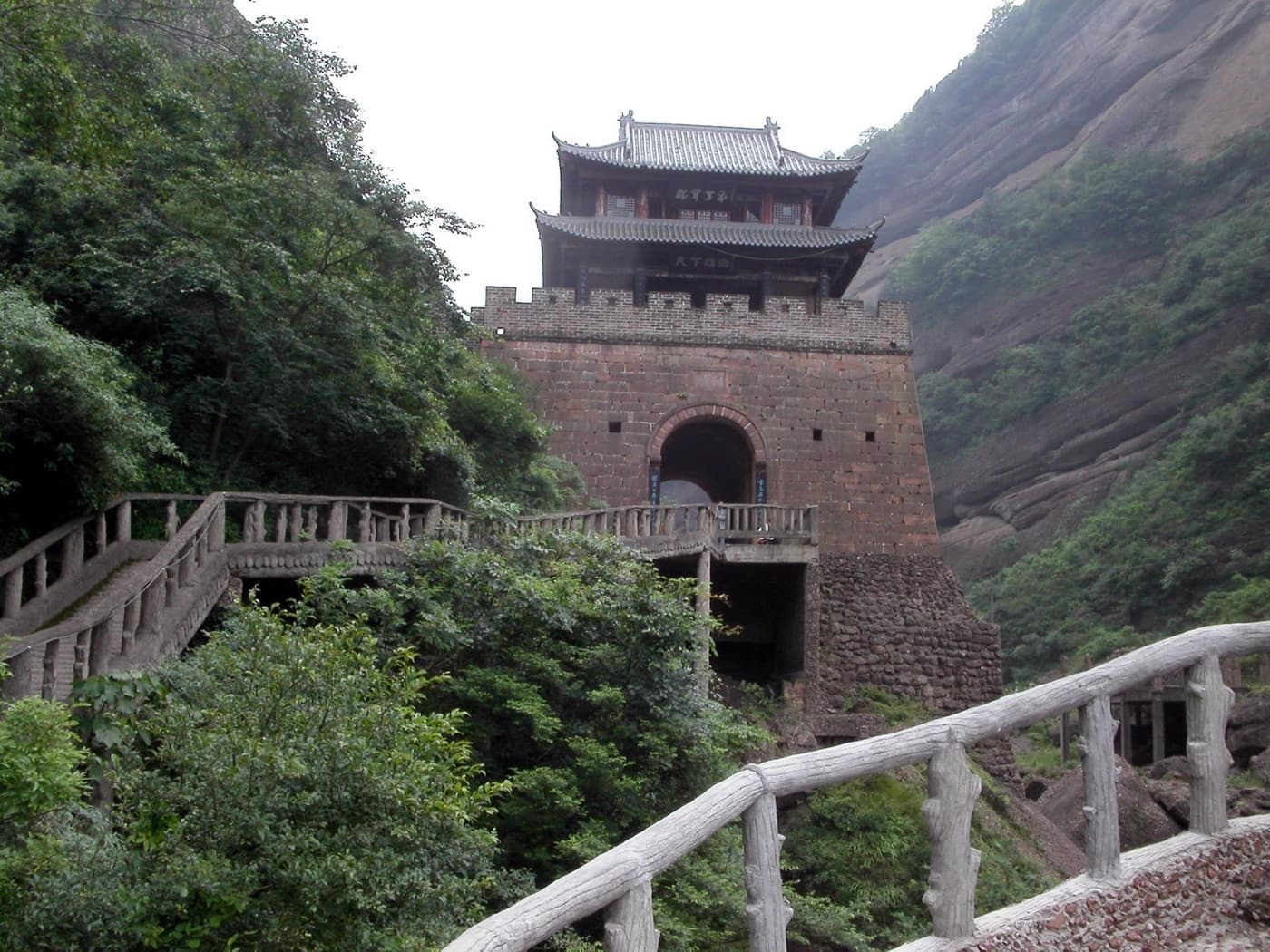
Jianmen Pass, Jiuzhaigou and Aba Prefecture · User:Munford · CC BY-SA 2.5 · Wikimedia Commons
Key facts
- Admission
- ¥105
- Opening hours
- 8:30–16:30 (January–April), 8:00–17:00 (April–November)
- Time needed
- 0.5–1 day
- Getting there
- Direct buses run from Guangyuan Bus Station (Nanhe Bus Station) to the Jianmen Pass scenic area.
- Guidebook rating
- 3 / 5
From China Self Guided Travel 2025, page 380. Open in Google Maps
About Jianmen Pass
‘The road to Shu is harder than climbing to the heavens’: this line from Li Bai captures the perils of the Shu Road, and only by standing at Jianmen Pass can you truly grasp the commanding force of its saying that one man holding the pass can stop ten thousand.
Jianmen Pass refers specifically to the mountain peaks between Guangyuan and Jiange, which have been carved by flowing water into steep, sword-like terrain. It is known as ‘the most formidable pass under heaven’. Only by being there can you truly appreciate the marvels of nature’s craftsmanship.
Tips from the guidebook
- 1. The three ancient Shu roads were Jinniu Road, Yinping Road and Micang Road. The most important, Jinniu Road, also called the Jianmen Shu Road, was the throat of the ancient Shu road network.
- 2. Cuiyun Corridor: Along the several dozen kilometres from Jianmen Pass to Jiange county town, unbroken rows of tall, straight ancient cypress trees line the road. This is the most distinctive section of the Jianmen Shu Road, known as the Cuiyun Corridor, also called the ‘Wonder of the Shu Road’.
Frequently asked questions
How much does Jianmen Pass cost?
Admission to Jianmen Pass is ¥105, as listed in the 2025 guidebook. Prices can change; check the official channel before you go.
What are the opening hours of Jianmen Pass?
Jianmen Pass is open 8:30–16:30 (January–April), 8:00–17:00 (April–November).
How do I get to Jianmen Pass?
Direct buses run from Guangyuan Bus Station (Nanhe Bus Station) to the Jianmen Pass scenic area.
How long should I spend at Jianmen Pass?
Plan on 0.5–1 day for Jianmen Pass.
Where is Jianmen Pass?
Jianmen Pass is in Jiuzhaigou and Aba Prefecture, Sichuan Province, in the Southwest of China.
More places in Jiuzhaigou and Aba Prefecture

Miyaluo and Bipenggou
The Miyaluo Golden Autumn Red Leaf Scenic Area is the largest and most spectacular red leaf scenic area discovered and opened in China to date. Its main attraction, Bipenggou, combines primeval forest, canyon scenery, lake waterfalls and snowy mountain meadows, where you can admire both snow and red leaves. Along the way to Miyaluo you pass Taoping Qiang Village, where you can see the most typical Qiang architecture, the diaolou (watchtowers). The towers are truly impressive.
Bipenggou admission plus shuttle bus within the park ¥60; Taoping Qiang Village ¥30 · Miyaluo: 2–3 hours; Bipenggou: 0.5–1 day

Huanglong National Scenic Area
Separated from Jiuzhaigou by a single mountain, Huanglong is remarkable for its glistening, smooth travertine rocks. The terraces wind up the gully like a golden dragon coiling its way upward. Within roughly one square kilometre behind Huanglong Temple lies the “golden” core of the scenic area. Less than 100 metres behind the rear temple stands the Dragon King Temple, where the annual Huanglong Temple Fair is held. Behind Huanglong Rear Temple rise the highest pools in the gully, the “Shitazhenhai” (Stone Pagoda Guarding the Sea), also known as the Five-Colour Pools. Visiting Huanglong without seeing these pools would be a great pity.
Peak season ¥170; off-season ¥60; cable car ¥80 up, ¥40 down · 1 day

Jiuzhaigou
No river is more colourful or pure than Jiuzhaigou's, and no mountain's foliage is more brilliant and varied. Here nature is never monochrome: in spring new buds turn green, in summer orioles and swallows dart about, in autumn the mountains blaze with red leaves, and in winter the ice gleams like jade. Water is the soul of Jiuzhaigou, which is why it is said that “once you have seen Jiuzhaigou's water, you need not see any other.” The Shuzhenggou section is the main valley, about 14 km long, with more than 40 lakes (haizi), roughly 40% of all the lakes in the scenic area. It is the entrance to Jiuzhaigou: every visitor passes through Shuzheng Valley. Key sights include Penjing Beach, Reed Sea, Huohua Lake, Shuzheng Waterfall, Rhinoceros Lake and Nuorilang Waterfall. The Rizegou section is the highlight of the Jiuzhaigou scenic line, with stunningly beautiful and ever-changing scenery. Sights include the Nuorilang Lake Group, Mirror Lake, Pearl Shoals Waterfall, Peacock Channel, Five-Flower Lake, Panda Lake Waterfall, Arrow Bamboo Lake, Eagle Claw Cave, Swan Lake, Fangcao Lake, Jianyan Hanging Spring and the primeval forest. The Zharugou valley is the longest valley developed so far in Jiuzhaigou, at 18 km. It passes Jiwan Lake and Five-Colour Pond before reaching Changhai (Long Lake) at an altitude of 3,100 metres.
Peak season: entrance ¥190, sightseeing bus ¥90; off-season: entrance ¥80, sightseeing bus ¥80 · 1 day
Lianbao Yezé
Lianbao Yeze is a famous sacred mountain in the Tibetan regions, ranked eighth among the region’s ten most sacred mountains. Some say it was the ancient battlefield where King Gesar waged his campaigns. Each sight in Lianbao Yeze has its own character. Longgacuo Lamahu Lake is the largest lake in the scenic area, with five smaller lakes surrounding the main lake. Legend says this is where King Gesar rescued his beloved consort Zhumu. Luoyun Co is another high-altitude freshwater lake. A huge ox-heart-shaped stone is reflected in its waters, creating a sight that is both spectacular and spiritual. Walk along the north shore for a while and you will see waterfalls dozens of metres high, which are truly dramatic. Zhumu Co has a different kind of grandeur. The Zhumu Lake, Zhumu River and Zhumu Gully together form a majestic world of lakes and rocks, with strange, precipitous mountains and peaks on both banks in countless shapes that invite the imagination.
¥60 · 2–4 hours
Dagu Glacier
The Dagu Snow Mountain stands within Sanda Ancient Village, Luhua Town, Heishui County, at an altitude of 3,800–5,100 metres. It boasts mountain glaciers, waterfalls, lakes, primeval forest, extensive rhododendron groves and scattered meadows. The ecology remains in excellent condition, and you can easily spot the small wildlife that lives here.
¥120; sightseeing bus ¥70; cable car ¥180 · 0.5–1 day
Kalonggou Scenic Area
Kalong Valley is a karst landscape, where stalactites come in dazzling colours. It has over a hundred colourful pools of varying sizes, dramatic waterfalls with steep drops, and autumn mountain forests painted in brilliant hues. Its scenery rivals and, in many ways, even surpasses that of Jiuzhaigou. Every October, the “Glacier and Autumn Forest Festival” is held here.
¥60 · 1 day