Northern Guangxi travel guide
桂北
Northern Guangxi's wonder lies in its towering mountains, rushing rivers and primeval forests, which set it apart from the Guilin area.…
13 places · In the guidebook: pages 2450–2460

Northern Guangxi, Guangxi Zhuang Autonomous Region · AI illustration for China Trip
Quick itinerary
Northern Guangxi in 2 days
The feel of the place
- Wondrous & Exotic
- Northern Guangxi's wonder lies in its towering mountains, rushing rivers and primeval forests, which set it apart from the Guilin area. Its exoticism lies in ethnic minority customs and architecture that differ markedly from those of Han Chinese regions. Northern Guangxi is home to the Zhuang, Yao, Miao, Dong, Shui, Gelao, Mulam and Maonan peoples. Their distinct cultural traditions and customs mean the region's wonders are not merely something to see, but something that touches the heart.
Things to see
Longsheng County Town is about 100 km from Guilin. The town itself has little to see; the best-known attraction is the magnificent Longji Rice Terraces. You can also experience the ethnic cultures of the Zhuang, Yao, Miao and Dong peoples.

Longji Rice Terraces
1–2 days · ¥80
This 650-year-old agricultural landscape is only a small part of what is here, yet it is stunning enough to take your breath away. The ancestors who carved these terraces out of the mountains could never have imagined that their sweat and lives would produce such graceful, curving scenery. Spectacular views combined with a touch of local culture make for an unforgettable visit. Along the way you will meet Yao women and Zhuang men, who make wonderful subjects for photography. Working villagers and the terraces at sunset create scenes that are beautiful beyond imagination. Best of all, you can stay in a family guesthouse, enjoy farmhouse chicken while looking out over the terraces, and experience the rhythm of terrace farming for yourself. To see the terraces at their most captivating, choose the right season. In April and May, the terraces are flooded and planted with rice, and the water glitters, making it the best time for photography and sightseeing. September is also worth considering, when the terraces turn golden with ripening grain.
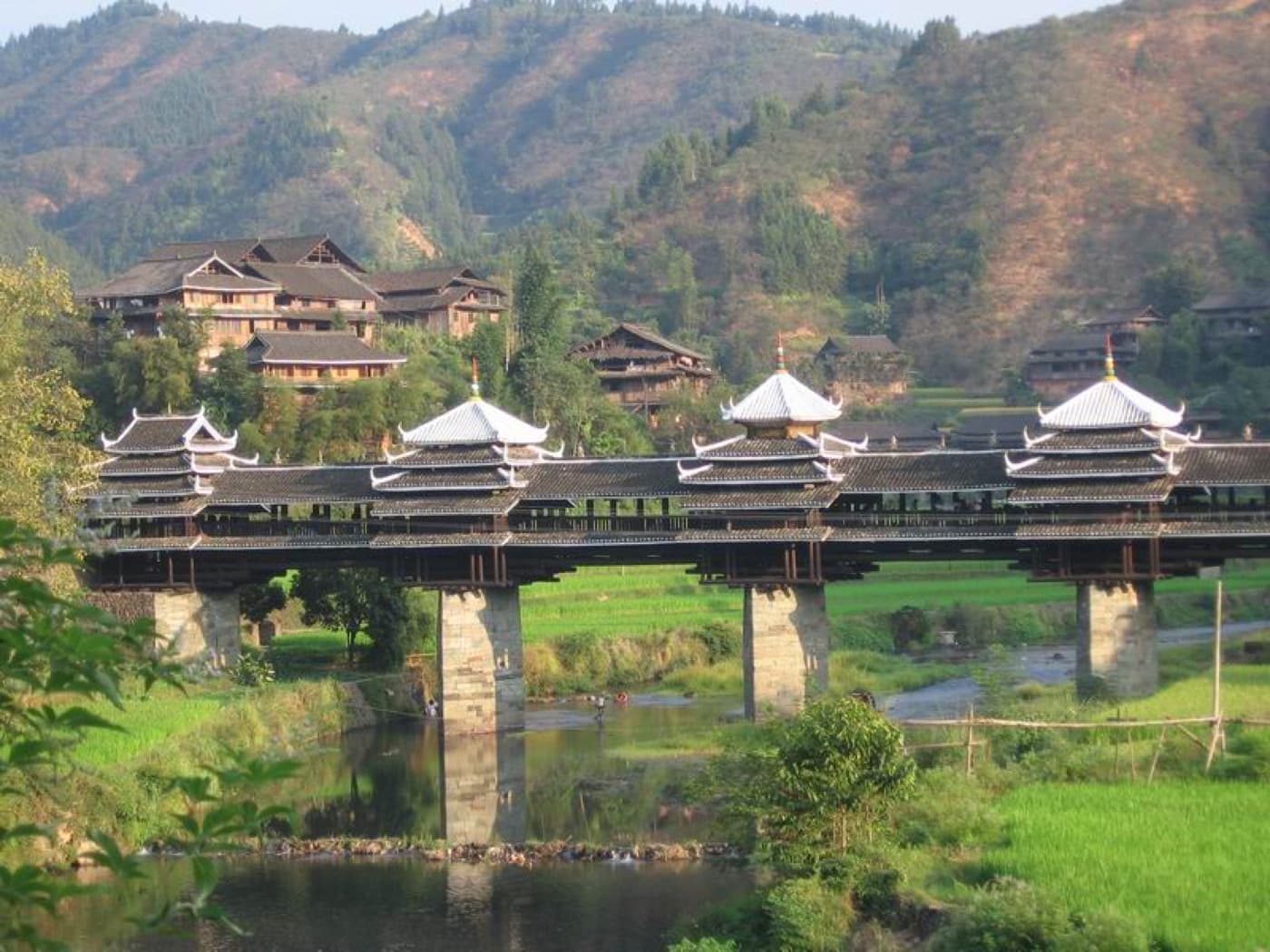
Chengyang Wind and Rain Bridge
30 minutes · ¥50
The Wind and Rain Bridge, also called Yongji Bridge (永济桥) or Panlong Bridge (盘龙桥), stands 20 km north of Guyi Town (古宜镇) in Sanjiang County, Liuzhou. This wooden bridge spans the Linxi River and is solidly built. Completed in 1916, it is a nationally protected cultural relic. China Post has also issued a commemorative stamp featuring Chengyang Bridge.
Huangluo Yao Village
Listed in the Guinness World Records for the longest hair of a group, Huangluo is known as “the village with the longest hair in the world.” Red Yao women with very long hair gathering by the river to wash it look like a folk painting. Villagers in Huangluo Yao Village are all skilled singers and dancers, and are famously hospitable. Performances here include long-hair displays, the red stick dance and the umbrella dance.
1–2 hours · Included in the Longji Rice Terraces ticket
Yinshui Dong Village
The Dong people who live here are skilled singers and dancers, and they have kept their distinctive customs and food traditions. Notable landmarks include the wooden houses built without nails, the wind and rain bridge at the village entrance, and the square, multi-eaved, pagoda-shaped drum tower with its flying-corner tiled roof.
1–2 hours · ¥50
Dong Village and Mapang Drum Tower
Dong villages have a distinctive structure, usually nestled between mountains and water. Houses are built from Chinese fir, packed closely together, and in many villages the homes connect into one continuous block, so you can walk through the village without being exposed to sun or rain. Seen from a distance, the villages rise and fall in a spectacular cascade. Almost every Dong village has a drum tower, usually at its centre, where villagers gather to discuss community affairs. The drum tower at Mapang Village (马胖寨), 25 km north of Sanjiang County town, is the largest and most representative in the Dong region. Built in 1939 by a Dong craftsman, it is highly prized for its beauty and is a nationally protected cultural relic.
Architecture · Old Towns & Villages · Ethnic Culture · Waterfront · Nature
Chengyang Eight Villages
The Chengyang Eight Villages are Ma'an (马鞍寨), Ping, Yan, Dong (董寨), Dazhai, Pingtan (平坦寨), Pingpu (平埔寨) and Jichang (吉昌寨). Visitors can watch folk performances that showcase Dong culture, with plenty to see and do. It is an excellent destination for sightseeing, photography and experiencing Dong culture. Chengyang Bridge is a precious cultural relic and deserves a close look.
0.5–2 days · ¥90 (includes sightseeing bus)
Longtan National Forest Park
This national AAAA-rated scenic area offers classic karst landscapes as well as the culture of southern ethnic minorities. Twenty-four peaks of varied shapes, including Wohu Shan (Crouching Tiger Mountain), Meinü Feng (Beauty Peak) and Kongque Shan (Peacock Mountain), rise around one lake (Jinghu, or Mirror Lake), two pools (Longtan and Leitan) and four valleys, forming a breathtaking landscape scroll.
2–3 hours
Zijiang River Rafting
The Zijiang River rises at Mao'er Mountain, 2,141.5 metres above sea level, and flows for more than 40 km with a natural drop of over 1,000 metres. The river is full of rapids and sharp bends: 58 rapids and 56 bends in total. The scenery along its banks is dramatic, with many attractions scattered along the way. Several wharves along the Zijiang allow visitors to launch rafting trips. On the section from Sanhao Wharf, the river is only a few dozen centimetres deep at its shallowest and more than 30 metres deep at its deepest; the route passes 33 bends and 45 rapids. The most challenging stretch is the Wupai River, where the water drops a striking 300 metres.
1–3 hours · Wooden boat ¥90/person; rubber raft ¥500/raft (up to 6 people), ¥350/raft (up to 3 people)
Bajiaozhai (Eight-Corner Fortress)
Located on the border between Hunan and Guangxi. Its vivid red rock mass rises abruptly into the sky, with eight horn-like peaks jutting from the summit, resembling eight majestic dragons soaring into the distance. The imposing, steep landscape is truly unique. From the Longtou Xiang (Dragon Head) viewpoint, you can gaze at distant danxia (red-rock) scenery, and up close you can see deep chasms and sheer cliffs.
2–3 hours · ¥148 (includes shuttle bus ticket)
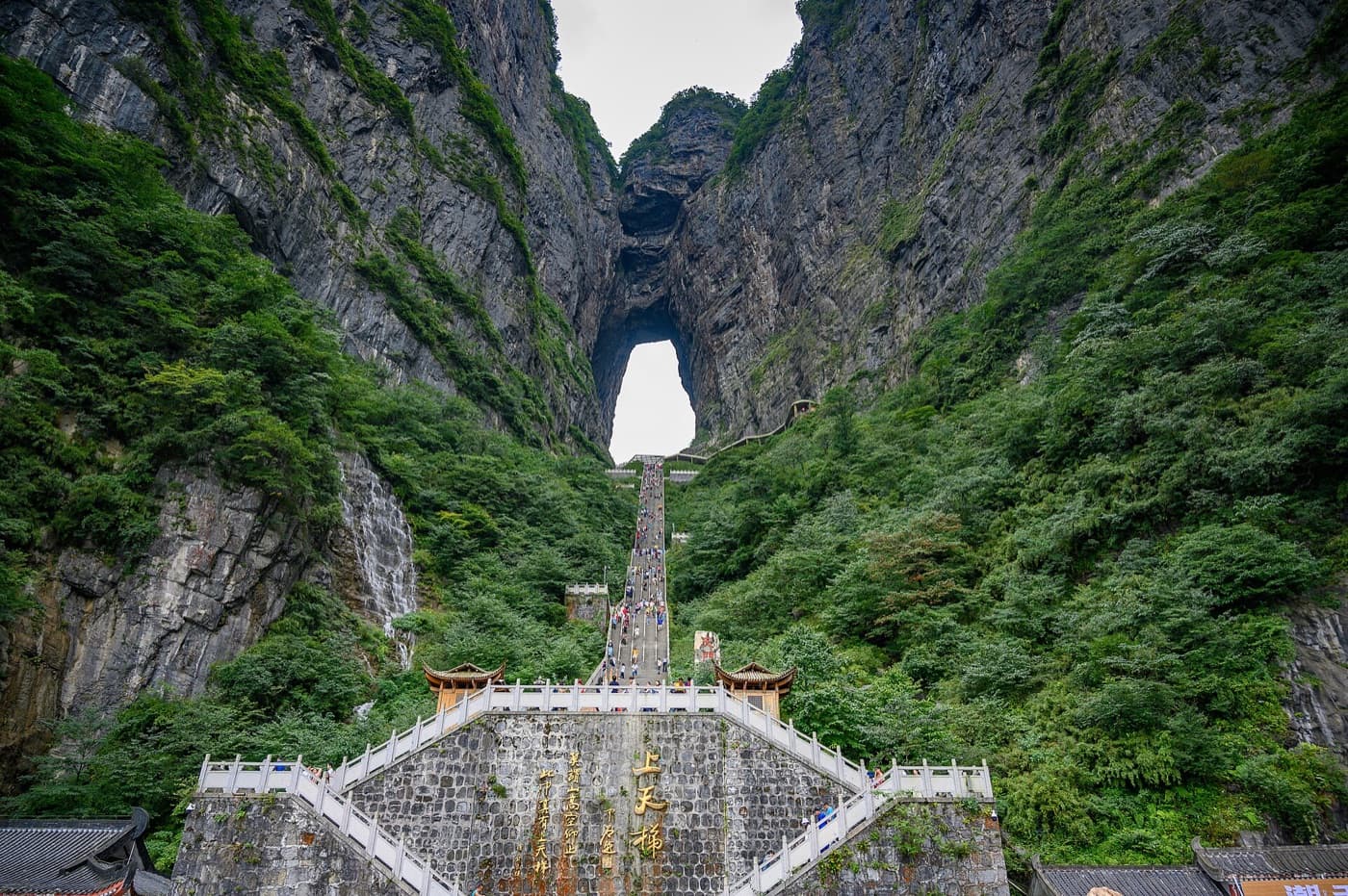
Tianmen Mountain
Tianmen Mountain has graceful peaks and striking ravines. Highlights include the typical danxia landforms of Tianji (Heavenly Ridge, a stone beam), Shenxian Zhai (Immortal Village, a stone stockade) and Yixian Tian (One-Line Sky, a narrow stone alley). Statues honour Shennong, the Emperor of Medicine; Zhang Zhongjing, the Sage of Medicine; and Hua Tuo, the Divine Physician. Religious buildings include Tianmen Temple, Guanyin Temple, the Medicine Buddha Hall and the Earth God Shrine. Inscriptions by renowned calligraphers include Zhao Puchu’s “Lin He You Mei” (Serene Forest and Valley), Lin Zhiyuan’s “Tianxia Diyi Yaogu” (The Number One Medicinal Valley Under Heaven) and Qin Yusheng’s “Zhi Zhe Le Shui” (The Wise Delight in Water), together creating a picture of a hidden paradise.
2–3 hours · ¥28
Dazhai Jinkeng Zhuang Village
A typical Zhuang village in China, known for its wooden houses built in tiers up the mountainside, forming spectacular “ladder houses” that best capture Zhuang culture. Here you can watch the Zhuang carrying-pole dance, often called “China's samba,” and listen to beautiful Zhuang mountain songs, experiencing authentic Zhuang culture.
2–3 hours
Xing'an Lingqu Canal
Completed in 214 BC, the Lingqu Canal, once known as Qin Zao Qu (Qin Dynasty Canal), is one of the world's oldest canals. Together with Dujiangyan and the Zheng Guo Canal, it is counted among the three great hydraulic projects of the Qin Dynasty.
Entrance ticket: ¥45
Mao'er Mountain
The highest peak in South China, located on the border between Xing'an and Ziyuan counties, with its main summit at about 2,141 metres above sea level. It is the source of three major Guangxi rivers: the Li (Lijiang), Zi (Zijiang) and Xun (Xunjiang).
4–5 hours · ¥160 (includes entrance ticket, sightseeing bus and insurance)
Getting there & around
Getting around Northern Guangxi relies mainly on roads. From Guilin to Longsheng, express buses take about 2 hours. From Longsheng, you can take a direct bus to Ziyuan or Sanjiang. For specific transport details, see the first section of each county.
Driving
If you can, drive around Longsheng; the scenery along the way will make the trip worthwhile. To see the rice terraces, choose the right season, or the trip will be wasted.
Eat & drink
The food of northern Guangxi is mainly shaped by local ethnic minority traditions and tends toward sour flavours. Its signature dishes are not especially outstanding, but most people find them perfectly acceptable.
The one drink you must not miss in northern Guangxi is the local liquor. There is the distinctive glutinous rice “water wine” of the Zhuang people of Longsheng, and the sweet potato spirit of the Yao people of Ziyuan, also known as “fire liquor”, which offers a very different flavour from the water wine.
Try the Dong people's sour meat, and make sure to taste the Yao people's “niaoxian”, which is a must. The latter is a famous local delicacy: wild birds caught in the mountains are plucked and cleaned, then mixed with toasted rice flour and salt and sealed in a jar for a period of time. A good “niaoxian” has tender, fragrant meat and crisp bones, and is outstandingly delicious.
Where to stay
Apart from Xing'an, the county towns of northern Guangxi have little distinctive character, so there is little point staying in town. It is better to stay in villages near the scenic spots. Not only can you watch the scenery at dawn and dusk, but you can also stay in Yao, Miao and Dong villages along the way, getting close to local life, experiencing authentic folk customs and discovering the unusual traditions of different ethnic groups.
Shopping
In the Yao, Miao and Dong villages of northern Guangxi, many women sell embroidered pouches, silver bangles and silver earrings. Prices are very low, and some of these are not actually made of silver, so take care to check before you buy.
Source: China Self-Guided Travel 2025 (《中国自助游》, Tianjin Science & Technology Press, Aug 2024), pp. 2450–2460. Translated from the Chinese edition; names and prices follow the guidebook. · Plain text version