Longtan National Forest Park
This national AAAA-rated scenic area offers classic karst landscapes as well as the culture of southern ethnic minorities. Twenty-four peaks of varied shapes,…
Longtan National Forest Park, Northern Guangxi
Key facts
- Time needed
- 2–3 hours
- Getting there
- Near Longtan Hospital (bus stop) and Longtan Community (bus stop)
- Guidebook rating
- 4 / 5
From China Self Guided Travel 2025, page 2456. Open in Google Maps
About Longtan National Forest Park
This national AAAA-rated scenic area offers classic karst landscapes as well as the culture of southern ethnic minorities. Twenty-four peaks of varied shapes, including Wohu Shan (Crouching Tiger Mountain), Meinü Feng (Beauty Peak) and Kongque Shan (Peacock Mountain), rise around one lake (Jinghu, or Mirror Lake), two pools (Longtan and Leitan) and four valleys, forming a breathtaking landscape scroll.
Frequently asked questions
How do I get to Longtan National Forest Park?
Near Longtan Hospital (bus stop) and Longtan Community (bus stop)
How long should I spend at Longtan National Forest Park?
Plan on 2–3 hours for Longtan National Forest Park.
Where is Longtan National Forest Park?
Longtan National Forest Park is in Northern Guangxi, Guangxi Zhuang Autonomous Region, in the South China of China.
More places in Northern Guangxi

Longji Rice Terraces
This 650-year-old agricultural landscape is only a small part of what is here, yet it is stunning enough to take your breath away. The ancestors who carved these terraces out of the mountains could never have imagined that their sweat and lives would produce such graceful, curving scenery. Spectacular views combined with a touch of local culture make for an unforgettable visit. Along the way you will meet Yao women and Zhuang men, who make wonderful subjects for photography. Working villagers and the terraces at sunset create scenes that are beautiful beyond imagination. Best of all, you can stay in a family guesthouse, enjoy farmhouse chicken while looking out over the terraces, and experience the rhythm of terrace farming for yourself. To see the terraces at their most captivating, choose the right season. In April and May, the terraces are flooded and planted with rice, and the water glitters, making it the best time for photography and sightseeing. September is also worth considering, when the terraces turn golden with ripening grain.
¥80 · 1–2 days
Chengyang Eight Villages
The Chengyang Eight Villages are Ma'an (马鞍寨), Ping, Yan, Dong (董寨), Dazhai, Pingtan (平坦寨), Pingpu (平埔寨) and Jichang (吉昌寨). Visitors can watch folk performances that showcase Dong culture, with plenty to see and do. It is an excellent destination for sightseeing, photography and experiencing Dong culture. Chengyang Bridge is a precious cultural relic and deserves a close look.
¥90 (includes sightseeing bus) · 0.5–2 days
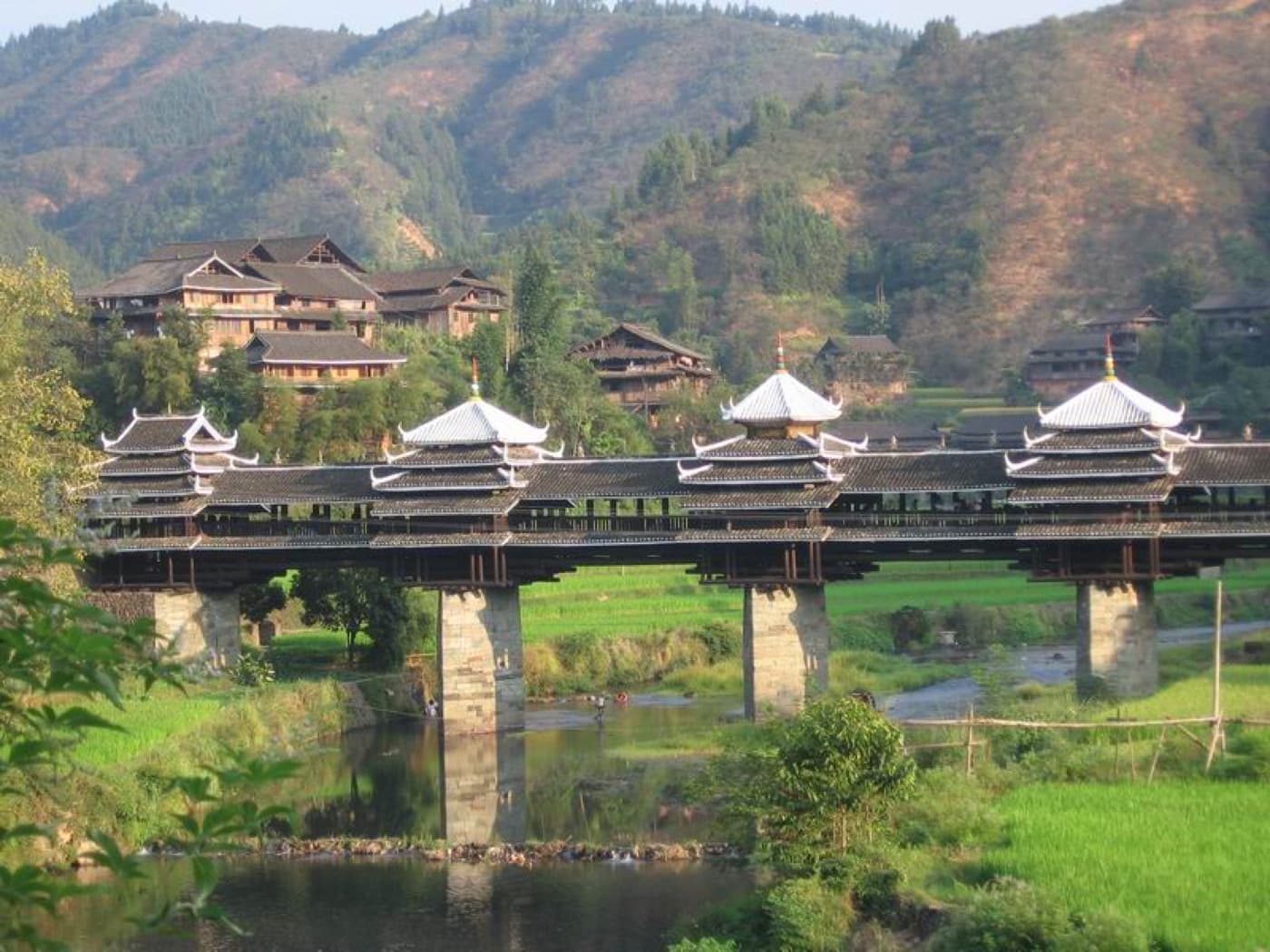
Chengyang Wind and Rain Bridge
The Wind and Rain Bridge, also called Yongji Bridge (永济桥) or Panlong Bridge (盘龙桥), stands 20 km north of Guyi Town (古宜镇) in Sanjiang County, Liuzhou. This wooden bridge spans the Linxi River and is solidly built. Completed in 1916, it is a nationally protected cultural relic. China Post has also issued a commemorative stamp featuring Chengyang Bridge.
¥50 · 30 minutes
Dong Village and Mapang Drum Tower
Dong villages have a distinctive structure, usually nestled between mountains and water. Houses are built from Chinese fir, packed closely together, and in many villages the homes connect into one continuous block, so you can walk through the village without being exposed to sun or rain. Seen from a distance, the villages rise and fall in a spectacular cascade. Almost every Dong village has a drum tower, usually at its centre, where villagers gather to discuss community affairs. The drum tower at Mapang Village (马胖寨), 25 km north of Sanjiang County town, is the largest and most representative in the Dong region. Built in 1939 by a Dong craftsman, it is highly prized for its beauty and is a nationally protected cultural relic.
Zijiang River Rafting
The Zijiang River rises at Mao'er Mountain, 2,141.5 metres above sea level, and flows for more than 40 km with a natural drop of over 1,000 metres. The river is full of rapids and sharp bends: 58 rapids and 56 bends in total. The scenery along its banks is dramatic, with many attractions scattered along the way. Several wharves along the Zijiang allow visitors to launch rafting trips. On the section from Sanhao Wharf, the river is only a few dozen centimetres deep at its shallowest and more than 30 metres deep at its deepest; the route passes 33 bends and 45 rapids. The most challenging stretch is the Wupai River, where the water drops a striking 300 metres.
Wooden boat ¥90/person; rubber raft ¥500/raft (up to 6 people), ¥350/raft (up to 3 people) · 1–3 hours
Yinshui Dong Village
The Dong people who live here are skilled singers and dancers, and they have kept their distinctive customs and food traditions. Notable landmarks include the wooden houses built without nails, the wind and rain bridge at the village entrance, and the square, multi-eaved, pagoda-shaped drum tower with its flying-corner tiled roof.
¥50 · 1–2 hours