Qianbu Beach (Thousand-Step Beach)
A wide, gently sloping expanse of soft, fine sand that rivals Silver Beach in Beihai, Guangxi. At the northern end, a huge boulder sits among the sand; when the tide goes out, the rock is revealed,…
Qianbu Beach (Thousand-Step Beach), Mount Putuo
Key facts
- Time needed
- 2–3 hours
- Getting there
- Take bus No. 2 and get off at Fayu Temple, then walk 200 metres to Qianbu Beach (Thousand-Step Beach)
- Guidebook rating
- 4 / 5
From China Self Guided Travel 2025, page 1198. Open in Google Maps
About Qianbu Beach (Thousand-Step Beach)
A wide, gently sloping expanse of soft, fine sand that rivals Silver Beach in Beihai, Guangxi. At the northern end, a huge boulder sits among the sand; when the tide goes out, the rock is revealed, inscribed with the words 'Listening to the Tide', and stone steps lead up from it to Wanghai Pavilion (Sea-Viewing Pavilion). If you happen to visit at high tide, swimming against the incoming waves is exhilarating. Blue sky, white clouds, rolling waves and sand; green mountains, emerald cypresses, Buddhist chanting and wisps of incense.
Frequently asked questions
How do I get to Qianbu Beach (Thousand-Step Beach)?
Take bus No. 2 and get off at Fayu Temple, then walk 200 metres to Qianbu Beach (Thousand-Step Beach)
How long should I spend at Qianbu Beach (Thousand-Step Beach)?
Plan on 2–3 hours for Qianbu Beach (Thousand-Step Beach).
Where is Qianbu Beach (Thousand-Step Beach)?
Qianbu Beach (Thousand-Step Beach) is in Mount Putuo, Zhejiang Province, in the East China of China.
More places in Mount Putuo

Mount Putuo
Mount Putuo has famous historic sites, a sunrise over the sea, and the hornbeam (a precious tree species rarely found in China). Who says Putuo isn't a famous mountain? Beside the South Heaven Gate is a cliff inscription, the four characters '海天大观' ('Grand View of Sea and Sky'), written by Lan Li, a Qing dynasty general of the Kangxi era; their bold, vigorous strokes make it another great attraction on Putuo. But Putuo's true appeal lies in its Buddhist tradition.
Main entrance ticket: ¥220 (includes round-trip ferry) · 2–3 days
Baibu Beach (Hundred-Step Beach)
East of Duobao Pagoda, also known as Ta Qian Sha (Sand in Front of the Pagoda), it stretches 660 metres, with a headland jutting into the sea in its midst, earning it the nickname 'Lion's Tail'. Gentle waves brush the golden sand, and the glow of the sunset reflects over it like spread glass. The shallows and open sea make for a charming scene. Pavilions stand on the rocky slopes at each end, both excellent spots for watching the sunrise. Baibu Beach is one of China's best-known seaside swimming beaches, and the only seaside beach on Mount Putuo with complete facilities.
Summer swimming ticket: ¥20 (includes shower) · 2–3 hours
Luojia Mountain
Legend has it that Guanyin Bodhisattva crossed the Lotus Ocean from here to establish her sacred site on Putuo. Since ancient times there has been a saying: 'Without visiting Luojia Mountain, your pilgrimage to Putuo is incomplete.' Owing to past destruction, everything here today has been rebuilt in later periods.
¥70 (includes round-trip ferry to Luojia Mountain) · 2–4 hours
Guanyin of the South Sea Statue
As you walk through Zizhu Lin (Purple Bamboo Grove), the sound of the tide drifts in from afar, and worldly cares seem to melt away. In the distance stands the 'Standing Statue of Guanyin of the South Sea', a symbol of the Buddhist realm where sea and sky meet. It is a place every Buddhist pilgrim must visit.
¥6 · 1 hour
Fodingshan (Buddha's Summit)
As the saying goes, 'If you haven't climbed Buddha's Summit, you haven't really been to Putuo.' The main sights on Buddha's Summit include Huiji Temple, the Haitian Buddhist Realm Cliff, Bodhisattva Summit and several others. Its main peak, Baihua Peak, is the highest point on Mount Putuo. Clouds often wreathe the summit, earning it the name 'Huading Cloud Waves' and making it one of the Twelve Scenes of Putuo. From the observation terrace at the top, you can take in sweeping views of the Putuo Ocean and the Lotus Ocean. Climbing Buddha's Summit to pay homage is a Putuo Buddhist tradition: on the 19th day of the second, sixth and ninth lunar months, devotees from across the country prostrate themselves every three steps as they ascend to worship Guanyin Bodhisattva.
3–4 hours
Puji Temple
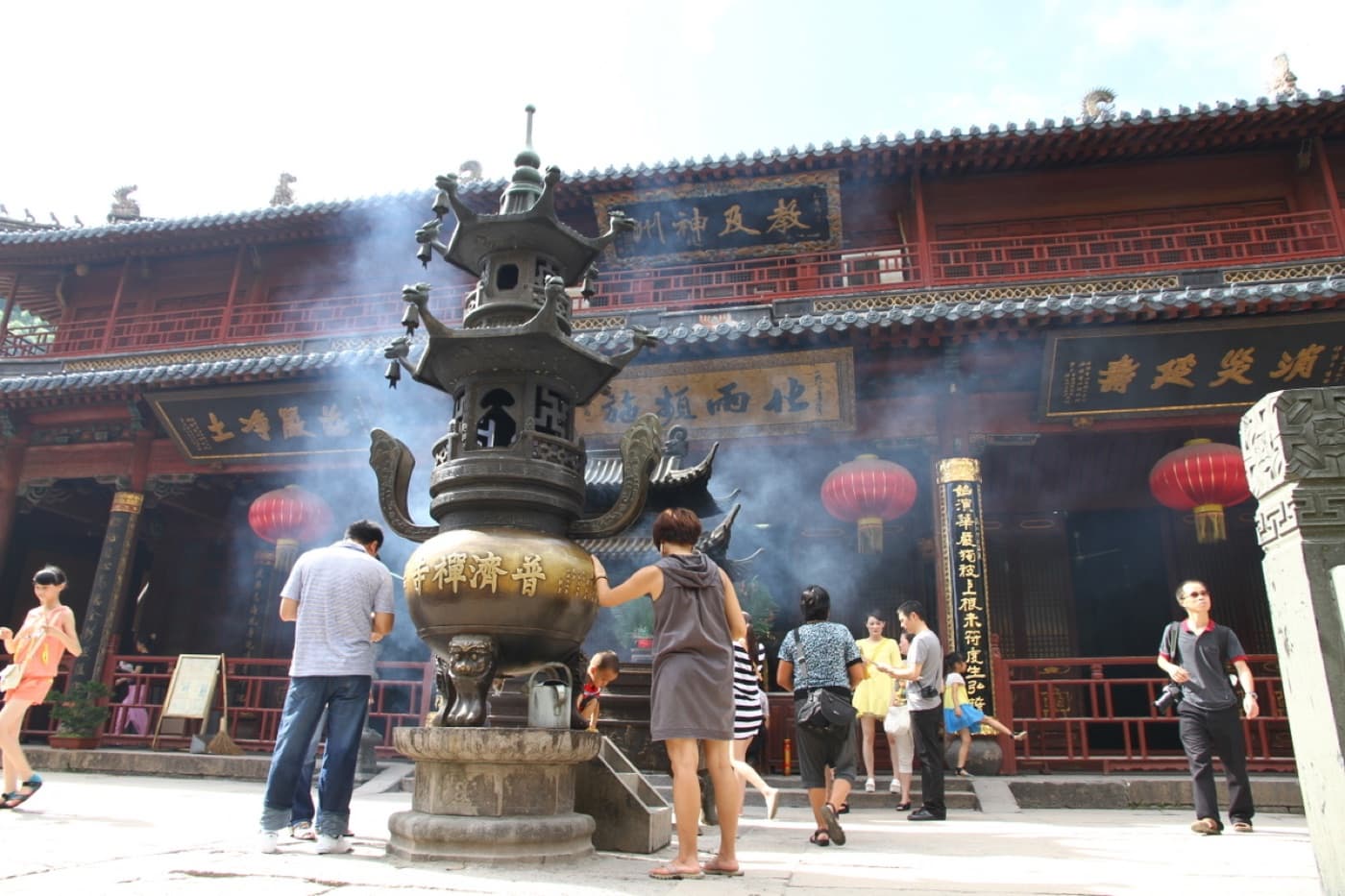
Puji Temple, together with Fayu Temple and Huiji Temple, is known as one of the three great temples, and it is one of the most incense-filled temples on the mountain. Its beauty is best appreciated with Haiyin Pond (Sea Seal Pond) as a backdrop: the pond is home to many red carp, and in summer the lotus flowers bloom, which is especially lovely.
¥5 · 1–2 hours