Labrang Monastery
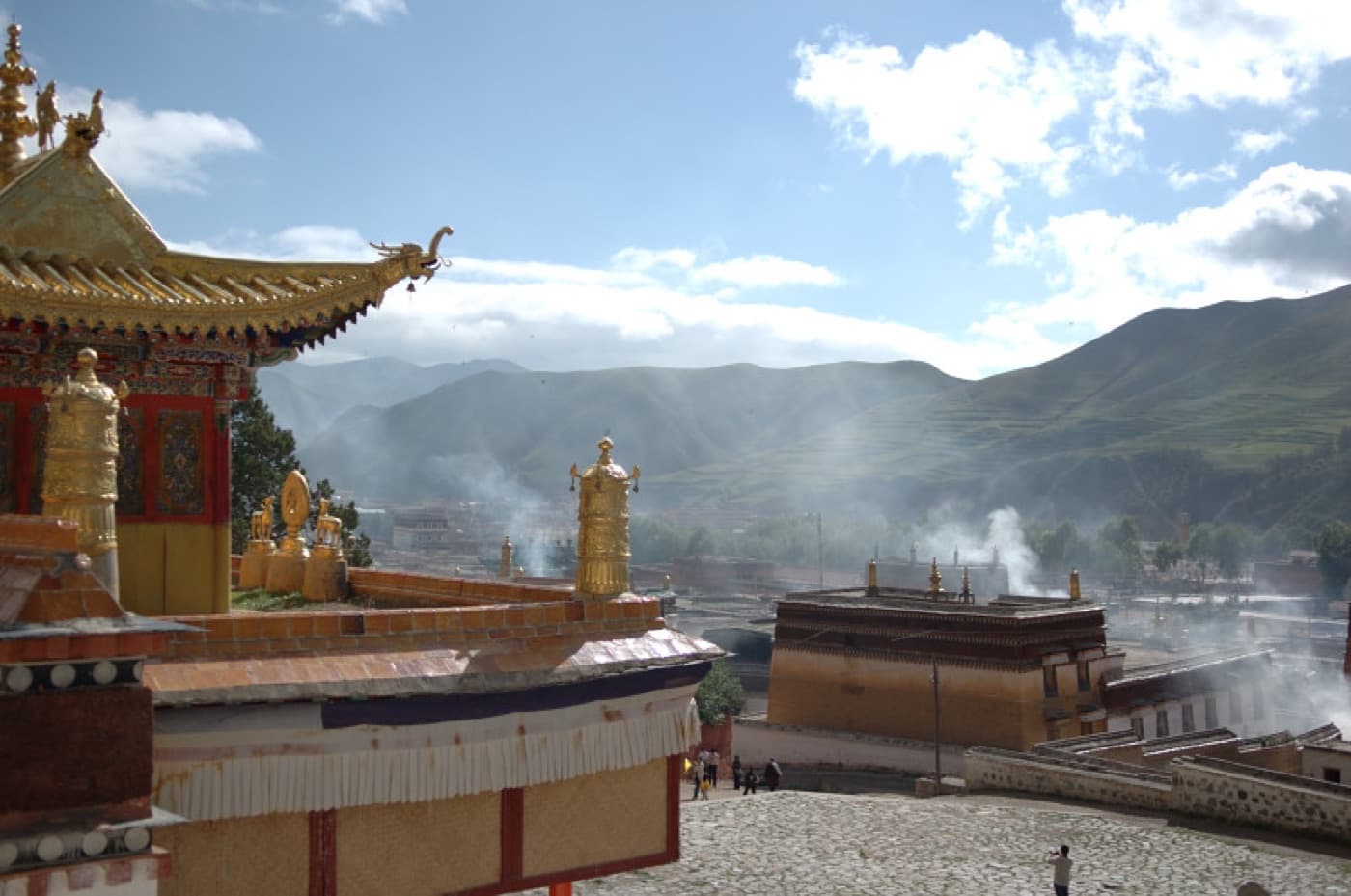
Founded in 1709, Labrang Monastery has six assembly halls, 84 Buddhist shrines, 31 towers, 30 Buddhist palace courtyards and more than 10,000 monks' residences.…

Labrang Monastery, Gannan · AI illustration for China Trip
Key facts
- Admission
- ¥40
- Opening hours
- 8:00–18:00 (May 1 – October 7); 9:15–16:30 (October 8 – April 30 of the following year)
- Time needed
- 3–4 hours
- Getting there
- Take a long-distance bus to Xiahe from Lanzhou, Linxia, Hezuo or other nearby cities. After getting off at the station, turn right and walk straight up the slope to reach the monastery.
- Guidebook rating
- 5 / 5
From China Self Guided Travel 2025, page 765. Open in Google Maps
About Labrang Monastery
Founded in 1709, Labrang Monastery has six assembly halls, 84 Buddhist shrines, 31 towers, 30 Buddhist palace courtyards and more than 10,000 monks' residences. It is also home to the world's longest row of prayer wheels, which encircles the monastery grounds. Labrang has six colleges: the Exoteric Studies College (Wensi), the Lower College of Esoteric Teachings, the Upper College of Esoteric Teachings, the Hevajra College, the Kalachakra College and the Medical College. It is the largest Tibetan Buddhist institute of learning in the world.
Incense is always burning at Labrang. It is especially lively during the great prayer festivals from the 4th to the 17th day of the first lunar month and from the 29th day of the sixth lunar month to the 15th day of the seventh lunar month, as well as during the Buddha-airing and scripture-debate events on the 13th day of the first lunar month and the 8th day of the seventh lunar month. Crowds of believers and monks gather from all directions to take part in or watch the prayer rituals, sacred dances, Tibetan opera, *Nanmote* performances and butter sculptures.
Frequently asked questions
How much does Labrang Monastery cost?
Admission to Labrang Monastery is ¥40, as listed in the 2025 guidebook. Prices can change; check the official channel before you go.
What are the opening hours of Labrang Monastery?
Labrang Monastery is open 8:00–18:00 (May 1 – October 7); 9:15–16:30 (October 8 – April 30 of the following year).
How do I get to Labrang Monastery?
Take a long-distance bus to Xiahe from Lanzhou, Linxia, Hezuo or other nearby cities. After getting off at the station, turn right and walk straight up the slope to reach the monastery.
How long should I spend at Labrang Monastery?
Plan on 3–4 hours for Labrang Monastery.
Where is Labrang Monastery?
Labrang Monastery is in Gannan, Gansu Province, in the Northwest of China.
More places in Gannan

Langmu Monastery
Langmu Monastery lies where the borders of Gansu, Qinghai and Sichuan meet. It is said to be the place where Padmasambhava subdued demons. It is a Tibetan Buddhist monastery and houses the stupa containing the physical remains of its first living Buddha.
¥30 · 1–3 hours
Milarepa Buddhist Palace
The Milarepa Buddhist Palace stands on a hillside north of Hezuo city and is the main monastery of the White Sect (Kagyu school) in the Amdo region. The original building dated to the Qianlong era of the Qing dynasty and was destroyed during the Cultural Revolution. The current structure was rebuilt in 1998. It has nine storeys, and each level is filled with Buddha statues and thangkas. At first glance its distinctive design looks like a high-end Tibetan-style hotel, and only two buildings in China share this architectural style.
¥20 · 1–2 hours
Sangke Grassland
Sangke Grassland, 10 km south of the Labrang Monastery area, is described in international travel guides as "a place rivalling the Native American grasslands in the film *Dances with Wolves*." It is also regarded as an auspicious land.
Free · 3–4 hours
Gahai Lake
Gahai, called "Cuoning" in Tibetan, meaning "where yaks wander," is the largest freshwater lake in the Gannan region. Every summer it becomes a sea of flowers and a kingdom of birds. Colourful wildflowers bloom along the lakeshore, and nearly a hundred rare bird species, including black-necked cranes, white swans, bar-headed geese and brown-headed gulls, gather in flocks. Birds fly and fish leap across the water while cattle and sheep graze leisurely. It is an ideal summer retreat.
¥50 · 1–2 hours
Zhagana Scenic Area
"Zhagana" means "stone casket." It is a complete natural "stone city." The explorer Joseph Rock compared it to a beautiful Garden of Eden, saying: "I have never seen scenery so magnificent in my life. This is truly virgin land, a sacred place for nature lovers and all sightseers." Its steep mountains and beautiful landscapes have earned it a place among the top ten "unknown peaks." Beneath the grand stone fortress lie villages with curling cooking smoke and simple, unpretentious folk customs, which many people imagine as a true peach-blossom paradise.
¥85 · 1 day
Yeliguan National Forest Park
Yeliguan is praised as "Yeliguan of mountains and waters, a great ecological garden" for its beautiful mountains and waters and its picturesque scenery. Its pleasant climate makes it an ideal summer resort. Highlights include the Heavenly Lake of Yehai, with its enchanting views, the lovely Yemu Gorge, and the wonderfully sculpted Chibi Valley.
Yehai Lake ¥60 per person, Chibi Valley ¥60 per person, Qinni Gully ¥60 per person, Lotus Mountain ¥30 per person, Forest Park ¥78 per person · 5–6 hours