Derong Sun Valley
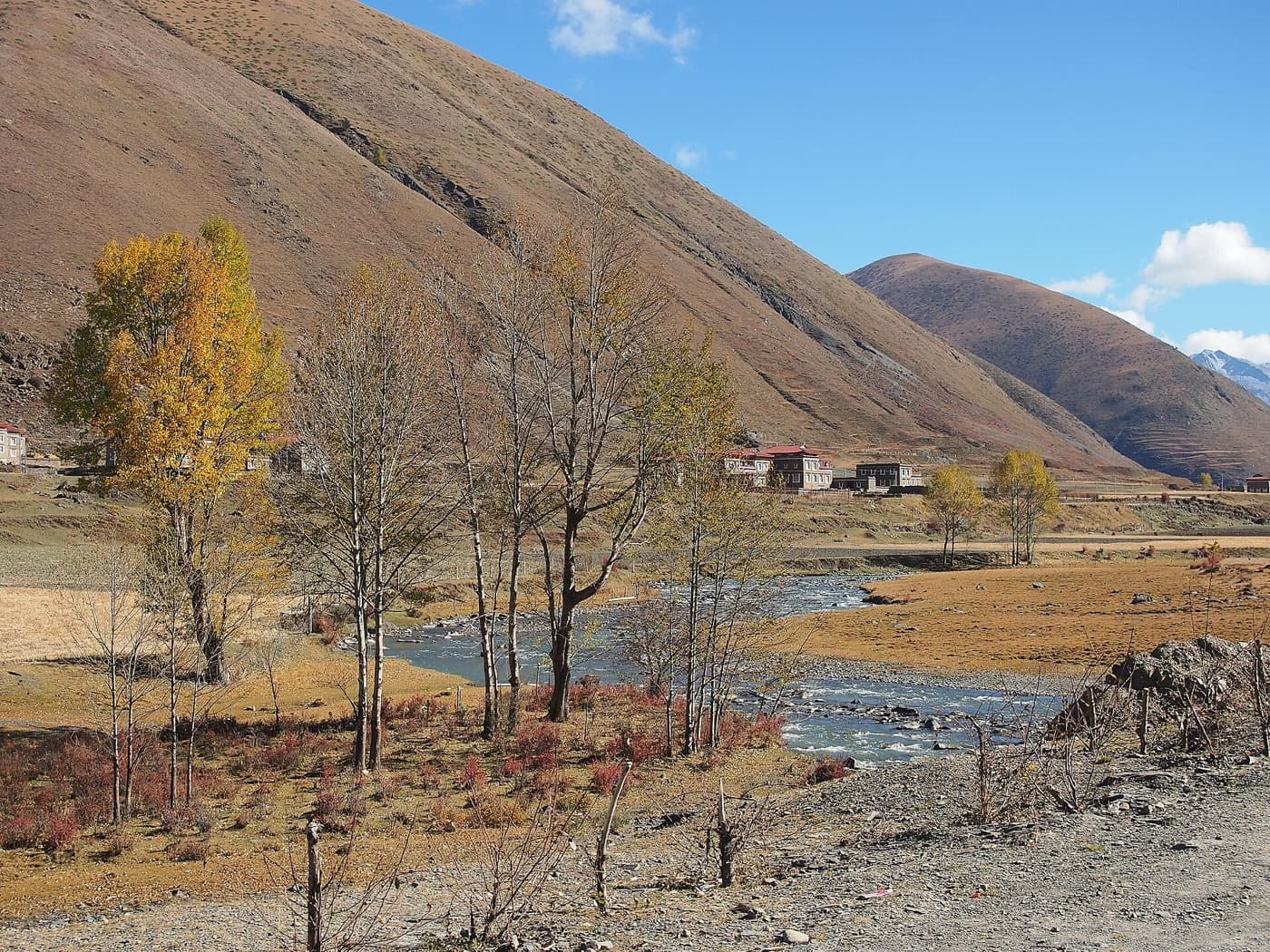
Derong Sun Valley remains a little-known, mysterious hidden valley, though more and more travellers are venturing out to explore it. Like the gorges of Shangri-La, its scenery is captivating.…
Derong Sun Valley, Garze Prefecture
Key facts
- Address
- Between Shangri-La and Deqen
- Getting there
- Take a bus from Chengdu to Kangding, then catch a bus from Kangding Bus Station to Derong County. One bus departs daily at 7:30.
- Guidebook rating
- 4 / 5
From China Self Guided Travel 2025, page 408. Open in Google Maps
About Derong Sun Valley
Derong Sun Valley remains a little-known, mysterious hidden valley, though more and more travellers are venturing out to explore it. Like the gorges of Shangri-La, its scenery is captivating. The villages and Wengjia Temple are natural and full of life, secluded and refreshingly unspoiled, and have yet to be discovered by many. These reasons alone are enough to make the arduous journey worthwhile for pilgrims.
Tips from the guidebook
- 1. Compared with places at the same altitude in Tibet, altitude sickness is less pronounced here, as the lush vegetation of Sun Valley keeps the air humid and rich in oxygen.
- 2. It is best to tour the scenic area on horseback. Horse rental costs ¥80–100 per day, and the local villagers are fairly trustworthy. Cars can reportedly drive up to an elevation of 3,000 metres, and riding a horse from there to the base camp takes about 2 hours. Currently, riding up from Xiayong Village takes over 4 hours, and the descent takes 3 hours.
Frequently asked questions
How do I get to Derong Sun Valley?
Take a bus from Chengdu to Kangding, then catch a bus from Kangding Bus Station to Derong County. One bus departs daily at 7:30.
Where is Derong Sun Valley?
Derong Sun Valley is in Garze Prefecture, Sichuan Province, in the Southwest of China. Between Shangri-La and Deqen
More places in Garze Prefecture

Larong Wuming Buddhist Academy
Serthar Larong Wuming Buddhist Academy is an enormous Buddhist academy. Beneath the deep blue sky and among the high mountain grasslands, thousands of small wooden cabins are densely packed across the hillsides around the academy’s main great assembly hall. The crimson cabins stretch and roll across the slopes, a truly spectacular sight. Many footpaths wind through the academy and are pleasant to stroll. On the hillside to the southwest of the prayer-wheel stupa, you can look down over the entire academy and capture its full panorama. On the highest peak within the academy stands a huge, gleaming golden mandala. Its red walls and golden roofs soar into the clouds, and each of its three tiers is brighter and more open than the one below, making the sacred site feel ever more solemn and majestic.
0.5–1 day

Daocheng Yading
In 1928, American explorer Joseph Rock arrived in Daocheng and published his photographs in National Geographic, causing a sensation. From then on, Daocheng Yading, long asleep in the ice of time, revealed its most ancient and innocent face, and people were enchanted by its allure as the ‘last pure land on the blue planet’. Chonggu Temple, Luorong Pasture, Five-Colour Lake and Milk Lake all have a serene, Shangri-La-like beauty. Among them, the most mysterious are the three sacred peaks. Chenrezig, Jambeyang and Chana Dorje stand in a triangular formation, collectively known as Nianqing Gongga Risong Gongbu. In Tibetan, the name means ‘the sacred site of three guardian mountains that never lose their snow’, and in Buddhism they are called the Three Protector Snow Mountains. This is a sacred mountain in Tibetan Buddhism, and for every Tibetan, making at least one pilgrimage circuit around Nianqing Gongga Risong Gongbu in a lifetime is a cherished wish.
¥146 (April–November), ¥120 (December–March), sightseeing bus ¥120 · 1–2 days
Shenmulei
A scenic area that has emerged in recent years, it is part of the Jiajin Mountain Scenic Area. Its main features are forests, snow-capped peaks, streams, alpine meadows and alpine calcified travertine pools. Major sights include Hongshanping, Shenmulei, the Colourful Pool and the Bijiaopo rhododendron forest. The most appealing feature is its well-preserved primeval forest.
Off-season ¥40; peak season ¥52
Tagong Grassland
“Tagong” means “a place the bodhisattvas love” in Tibetan. It is a pure pastoral grassland under a sky as clear as washed glass. In summer and autumn, the grassland hosts a grand traditional horse race. Tagong Monastery is one of the famous temples, known as the “Little Jokhang”. It enshrines three life-sized statues of Shakyamuni Buddha at age 12 and is one of the pilgrimage sites for Tibetans in the Kham region. Each year, from the 6th to the 17th day of the sixth Tibetan month, during the Dharma Protector Festival, “Cham” (sacred dance) performances are held. To the left of the monastery is a forest of stupas, among which the red, yellow, white and green stupas are the most famous. Behind the monastery rise three sacred mountains, covered with mani stones and prayer flags, spectacular and mysterious.
Free · 3–4 hours
Xinduqiao Town
Xinduqiao has no outstanding landmark, but along the road is a stretch of more than 10 kilometres known as the “Photographers’ Corridor”. Travellers on the Sichuan–Tibet Highway who stop to admire the scenery can indulge their passion for photography here. From this area you can also gaze into the distance at Mount Gongga, the “King of the Shu Mountains”.
2–3 hours
Mugecuo Scenic Area
At an altitude of about 4,000 metres, “Mugecuo” means “Wild Man Sea” in Tibetan. It combines primeval forest, grassland, snow-capped mountains and lakes, and is like a condensed version of Jiuzhaigou. The Great Sea of Muge Lake embodies the world-famous “3S” tourism elements of sun, sand and sea. The Yaochi hot springs have nearly a hundred mineral springs with different therapeutic effects. The most remarkable sight is the red loaches swimming in the 80℃ medicinal pool. Muge grassland connects with Tagong Grassland.
¥105 (April–November); ¥75 (December–March) · 3–4 hours