Danba Beauty Valley
Danba's beauties have long been famous, and Qiongshan Village (邛山村) in Badi Township (巴底乡), known as “Beauty Valley,” is where they are gathered at their finest.…
Danba Beauty Valley, Garze Prefecture
Key facts
- Time needed
- 1 day
- Getting there
- Take a taxi from the Danba county seat.
- By car
- Head north from the county seat along National Highway 248, passing Jiaju Tibetan Village on the way. The total distance is about 32 km and the drive takes about 1 hour.
- Guidebook rating
- 4 / 5
From China Self Guided Travel 2025, page 398. Open in Google Maps
About Danba Beauty Valley
Danba's beauties have long been famous, and Qiongshan Village (邛山村) in Badi Township (巴底乡), known as “Beauty Valley,” is where they are gathered at their finest. Legend has it that when the Western Xia kingdom was destroyed by Mongol cavalry, many beautiful women fled from Gansu and settled here, giving rise to the internationally renowned Beauty Valley. That these beauties have continued generation after generation is likely thanks to the nourishing rivers and valleys.
Frequently asked questions
How do I get to Danba Beauty Valley?
Take a taxi from the Danba county seat.
How long should I spend at Danba Beauty Valley?
Plan on 1 day for Danba Beauty Valley.
Where is Danba Beauty Valley?
Danba Beauty Valley is in Garze Prefecture, Sichuan Province, in the Southwest of China.
More places in Garze Prefecture

Larong Wuming Buddhist Academy
Serthar Larong Wuming Buddhist Academy is an enormous Buddhist academy. Beneath the deep blue sky and among the high mountain grasslands, thousands of small wooden cabins are densely packed across the hillsides around the academy’s main great assembly hall. The crimson cabins stretch and roll across the slopes, a truly spectacular sight. Many footpaths wind through the academy and are pleasant to stroll. On the hillside to the southwest of the prayer-wheel stupa, you can look down over the entire academy and capture its full panorama. On the highest peak within the academy stands a huge, gleaming golden mandala. Its red walls and golden roofs soar into the clouds, and each of its three tiers is brighter and more open than the one below, making the sacred site feel ever more solemn and majestic.
0.5–1 day

Daocheng Yading
In 1928, American explorer Joseph Rock arrived in Daocheng and published his photographs in National Geographic, causing a sensation. From then on, Daocheng Yading, long asleep in the ice of time, revealed its most ancient and innocent face, and people were enchanted by its allure as the ‘last pure land on the blue planet’. Chonggu Temple, Luorong Pasture, Five-Colour Lake and Milk Lake all have a serene, Shangri-La-like beauty. Among them, the most mysterious are the three sacred peaks. Chenrezig, Jambeyang and Chana Dorje stand in a triangular formation, collectively known as Nianqing Gongga Risong Gongbu. In Tibetan, the name means ‘the sacred site of three guardian mountains that never lose their snow’, and in Buddhism they are called the Three Protector Snow Mountains. This is a sacred mountain in Tibetan Buddhism, and for every Tibetan, making at least one pilgrimage circuit around Nianqing Gongga Risong Gongbu in a lifetime is a cherished wish.
¥146 (April–November), ¥120 (December–March), sightseeing bus ¥120 · 1–2 days
Danba Danglin Natural Scenic Area
A source of pride for Danba, at an altitude of 5,000 m, with pristine vegetation and countless lakes scattered like stars. Said to rival or even surpass Jiuzhaigou in natural scenery. The natural hot springs at Dangling are the best in the entire county. Soak in the hot springs for half a day, then rent a horse and hire a guide to climb up and see the lakes. There is no greater pleasure in life.
Suopo Ancient Watchtowers
Suopo has 84 ancient watchtowers, the most concentrated cluster of such towers in all of Danba and indeed the world, including the world's only pentagonal watchtower. Built from earth and stone, the towers stand upright and straight, with sharp, knife-edge corners, and their walls of stacked stone are thick and sturdy. Most are attached to residential watchtower-houses, while others stand alone on flat ground or in valleys. Despite centuries of wind and weather, they still rise defiantly, displaying a majestic grandeur.
Free, but the owners of the watchtowers charge a fee when you climb up to visit.
Ancient Villages around Danba County Seat
Pujiaoding Township (蒲角顶乡): 7 km from the county seat, at an altitude of 2,300 m. One of its 29 ancient watchtowers has a thirteen-sided design, and it is also the best spot from which to view the Suopo watchtower cluster from afar. Zhonglu Township (中路乡): 10 km from the county seat, at an altitude of 2,000 m. Besides watchtowers and Tibetan villages, it has ancient human settlement sites older than Sanxingdui and Neolithic stone-coffin burial grounds. Moska Village: Surrounded by three sacred mountains, the herders here live a secluded, poetic life. In this pristine land, people and wildlife coexist in harmony, which is why some call it “the Lost Paradise.”
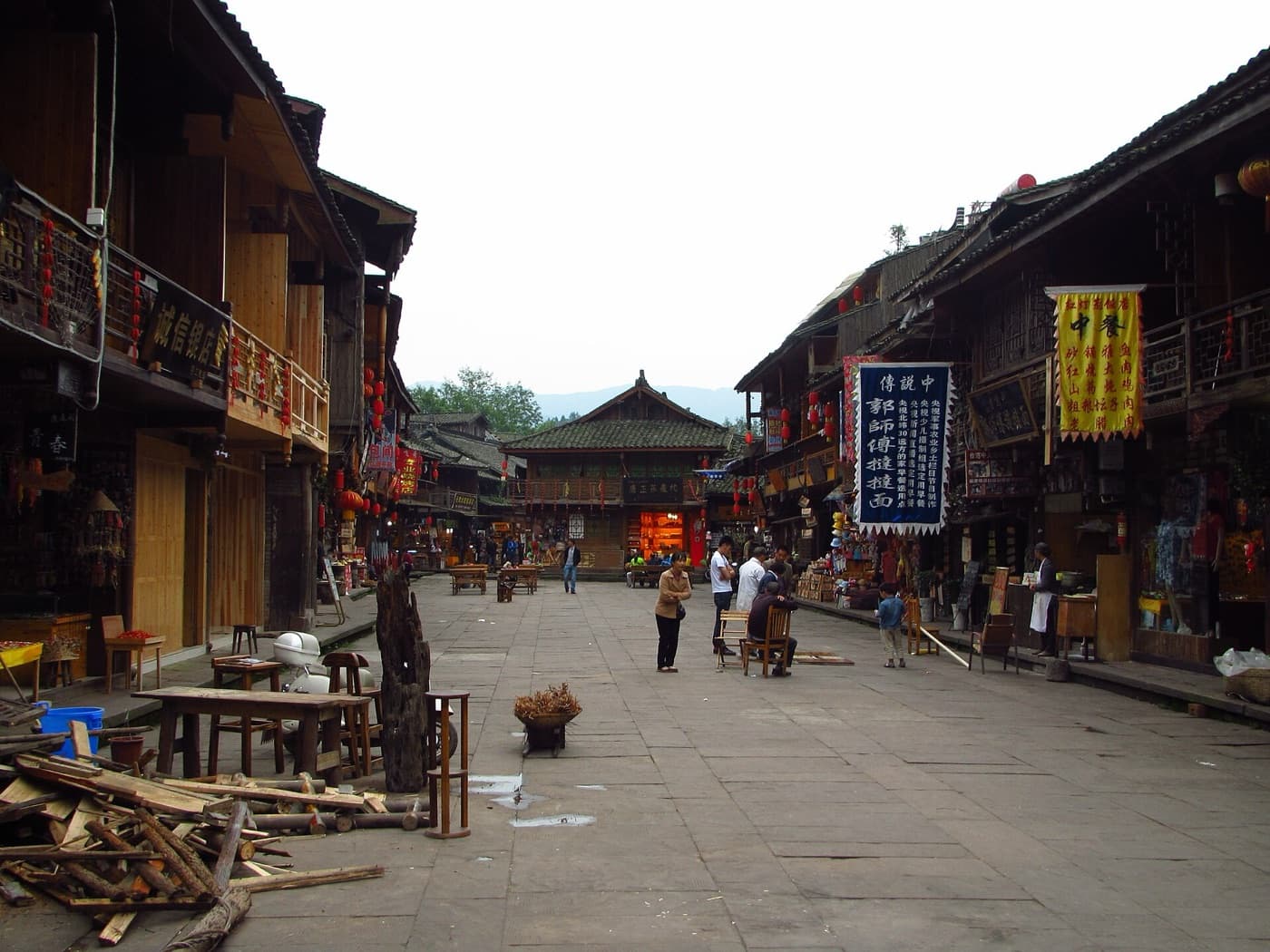
Shangli Ancient Town
Shangli Ancient Town, north of Ya'an city, was once an important post station on the Southern Silk Road. It is now a rising tourist destination. Its Ming and Qing dynasty residences are well preserved, and its eight ancient stone bridges, led by Erxian Bridge, each have a distinctive style. The White Horse Spring, dating back to the Tang dynasty, is a constant-temperature intermittent geyser and quite remarkable.
3 hours