Wuyuan travel guide
婺源
The character “婺” is pronounced wù. Mentioning this may seem a little unnecessary, but you'll understand once you're there. Locals often write “婺源” as “务源,” probably to simplify the characters. For an outsider,…
12 places · In the guidebook: pages 1479–1490

Wuyuan, Jiangxi Province · AI illustration for China Trip
Quick itinerary
Wuyuan in 3 days
- Day 1
- Wuyuan→
- Moon Bay→
- Likeng→
- Wangkou→
- Jiangwan→
- Huangling (overnight stay)
- Day 2
- Day 3
The feel of the place
- Wuyuan
- The character “婺” is pronounced wù. Mentioning this may seem a little unnecessary, but you'll understand once you're there. Locals often write “婺源” as “务源,” probably to simplify the characters. For an outsider, knowing this makes a big difference when you're standing at the ticket window of the station.
- Huizhou Culture
- Wuyuan is now administratively part of Jiangxi, but for about a thousand years it belonged to Huizhou, serving as one of the six counties of Huizhou. They say there are three taboos when visiting Wuyuan, and the first is never to call its people “Jiangxi laobiao” (country cousins). Ancient villages, rivers reflecting the hallmark of Huizhou-style architecture—horse-head gables (马头墙), white walls and grey tiles, and roofs with upturned eaves carved with all kinds of patterns, reaching toward the sky and standing out strikingly against the blue sky and green trees. Wuyuan is one of the old roots of Huizhou culture, rich in content and deep in heritage, and it has developed distinctive schools and styles in many fields. Whether in Neo-Confucianism, painting, architecture or language, Huizhou culture influenced almost all of Chinese culture during the Ming and Qing dynasties. Administratively, Wuyuan no longer belongs to Anhui, but it cannot be separated from Huizhou culture.
- Wuyuan Girls
- Wuyuan's young women are a pleasant surprise. Once you enter Jiangxi, beautiful women seem far less common than in Jiangnan, yet Wuyuan girls each have a demure, graceful charm and the pure elegance of a lotus rising from the water. The evening scene by the river in Wuyuan County town is especially striking. The girls have a habit of strolling along the riverbank, and when the setting sun reflects on the water, they become a scene in their own right.
Walking Rhyme
To make the most of Wuyuan, memorise the Wuyuan Walking Rhyme: “To see the mountains, head east, not west; to see the water, head north, not south; stay outside the city, not inside; take the bus early, don't delay.”
Preparation and Enquiries
Language
The Jiangxi accent is not too hard to understand, though it sounds less soft, and communicating in Mandarin is no problem.
Climate and Best Season
Wuyuan is at its most beautiful in spring and summer, especially in April, when azaleas already carpet the hillsides, joined by green tea bushes and yellow rapeseed flowers. That is why some say Wuyuan is China's most beautiful countryside. July and August also offer pleasant scenery and weather.
Things to see
A Wuyuan Scenic Area pass costs ¥210 per person. It is valid for 120 hours (5 days) and gives access to Wuyuan's major attractions. Once you collect the ticket, you must validate it within half an hour.
Likeng Village (Ikeng)
2 hours · ¥60
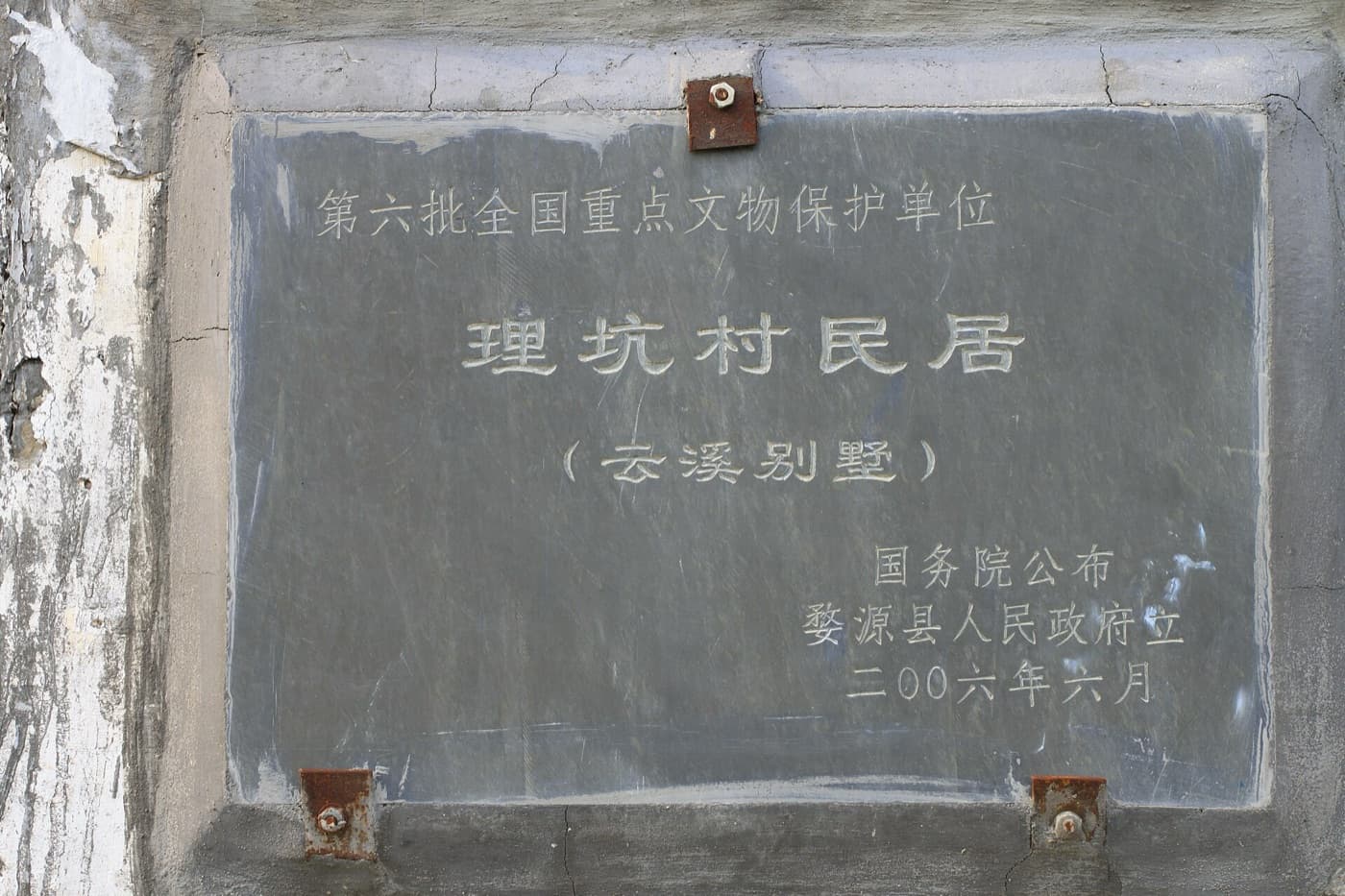
Ikeng Village was founded in the early Southern Song dynasty. Its villagers are well-educated and courteous to their neighbours. The village preserves many Ming and Qing official residences, such as the Shangshu Residence, the Tianguan Shangqing Residence and Jiamu Hall. All are exquisitely crafted, with bracketed eaves and upturned roof corners. Pine trees and bamboo set off the black-tiled, white-walled houses, while ancient paths, stone bridges and rushing streams complete a picture of remarkable harmony.
Jiangling
4 hours · ¥80
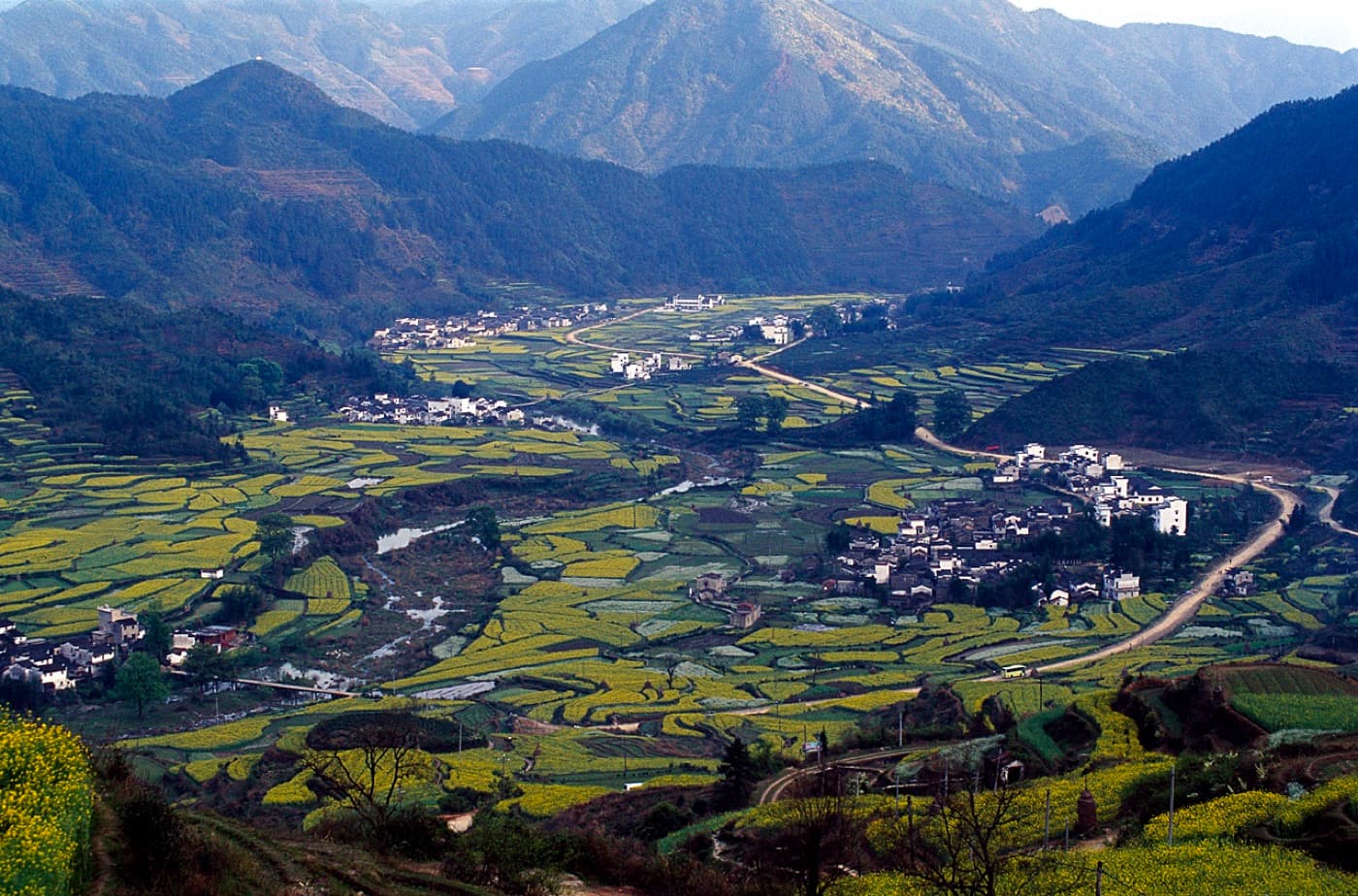
'You haven't truly seen Wuyuan until you've been to Jiangling.' Jiangling is the most beautiful village for viewing terraced rapeseed fields. From the high ground you can see the most magnificent rapeseed flowers and the most graceful Hui-style houses. The best viewpoint is on the hill, where the rapeseed flowers blanket the slopes in a spectacular display just before Qingming Festival. The hills are not high, but the paths are dirt roads that become difficult in the rain. You can also take a motorbike taxi up and down.
Jiangwan
Jiangwan is an ancient village rich in Huizhou cultural heritage, famous as the hometown of Jiang Zemin. It still preserves Ming and Qing official residences such as the Yushi Mansion and the Zhongxian Mansion, as well as Huizhou-style merchant houses such as the Tengjia Old House and Peixin Hall. Four ancient gate pavilions, Donghe, Nanguan, Xi'an and Beiyue, are also part of the village's landscape. Among its sights, the Xiaojiang Ancestral Hall was once hailed as 'the finest of the 70 famous ancestral halls in the Jiangnan region.'
3 hours · ¥60
Likeng Scenic Area
Likeng is one of the most famous villages in Wuyuan and is considered one of China's most beautiful villages. Its architecture is distinctively Hui-style. The village has a long tradition of scholarship and has produced many talented people. Ming and Qing period buildings are scattered throughout the village, and residential compounds are built along the stream. Likeng grilled meat (zhirou) and Huagu shiji (a shiitake and chicken dish) are farmhouse specialties you must try here, and pairing them with Likeng glutinous rice wine makes the meal even better.
2–3 hours · ¥60
Upper and Lower Xiaoqi
Upper and Lower Xiaoqi are the two most beautiful villages in Wuyuan. This area preserves some of the best-kept natural scenery in Wuyuan and best embodies the region's pastoral theme. The key is to set aside time and savour them slowly. Upper Xiaoqi is known for its hillside farmland. From here you can continue up to Jiangling, where the views of fields and countryside make it one of the most beautiful spots in Wuyuan. Lower Xiaoqi is distinguished by the water that winds around the village. When travelling from Wangkou Town toward Duanxin (段辛), turn onto a dirt road. Lower Xiaoqi, surrounded by ancient trees, sits where two streams meet.
Old Towns & Villages · Hiking & Outdoors · Photography
Sixi and Yancun Villages
Located on the southwest side of the town, Sixi Yancun backs onto hills and faces water, nestled in a natural setting of brocade-like peaks and clear streams. Its clusters of houses blend skilfully with the environment, so that mountains and water merge into one. Poetic and picturesque, the village has deep artistic appeal. Because the TV series Strange Tales of Liaozhai was filmed here, it is known as the 'Liaozhai Film and TV Village.' The mysterious 'Liaozhai Cottage' from the series is tucked away among the ancient residences.
2–3 hours · ¥55
Shicheng Village
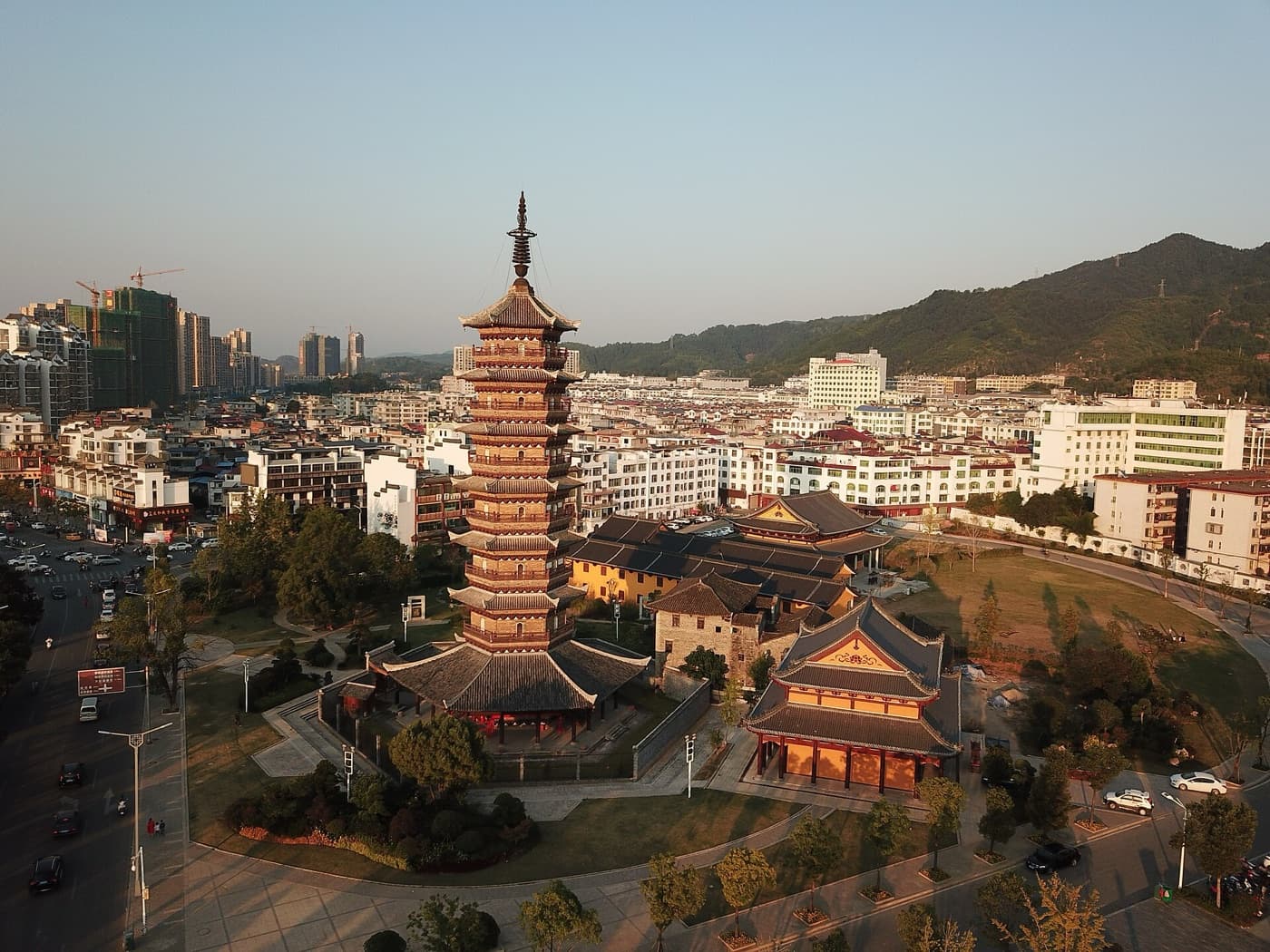
Shicheng Village is home to a remarkable collection of ancient trees, with groves of rare species. Its more than 100 maple trees are especially striking. From mid-to-late November, when the maple leaves begin to turn red, photography enthusiasts arrive at dawn and stay until dusk. The vivid colours set against black-and-white ancient houses form a natural giant palette. In autumn in Wuyuan, Shicheng and Changxi are two villages not to be missed.
2–3 hours
Huangling
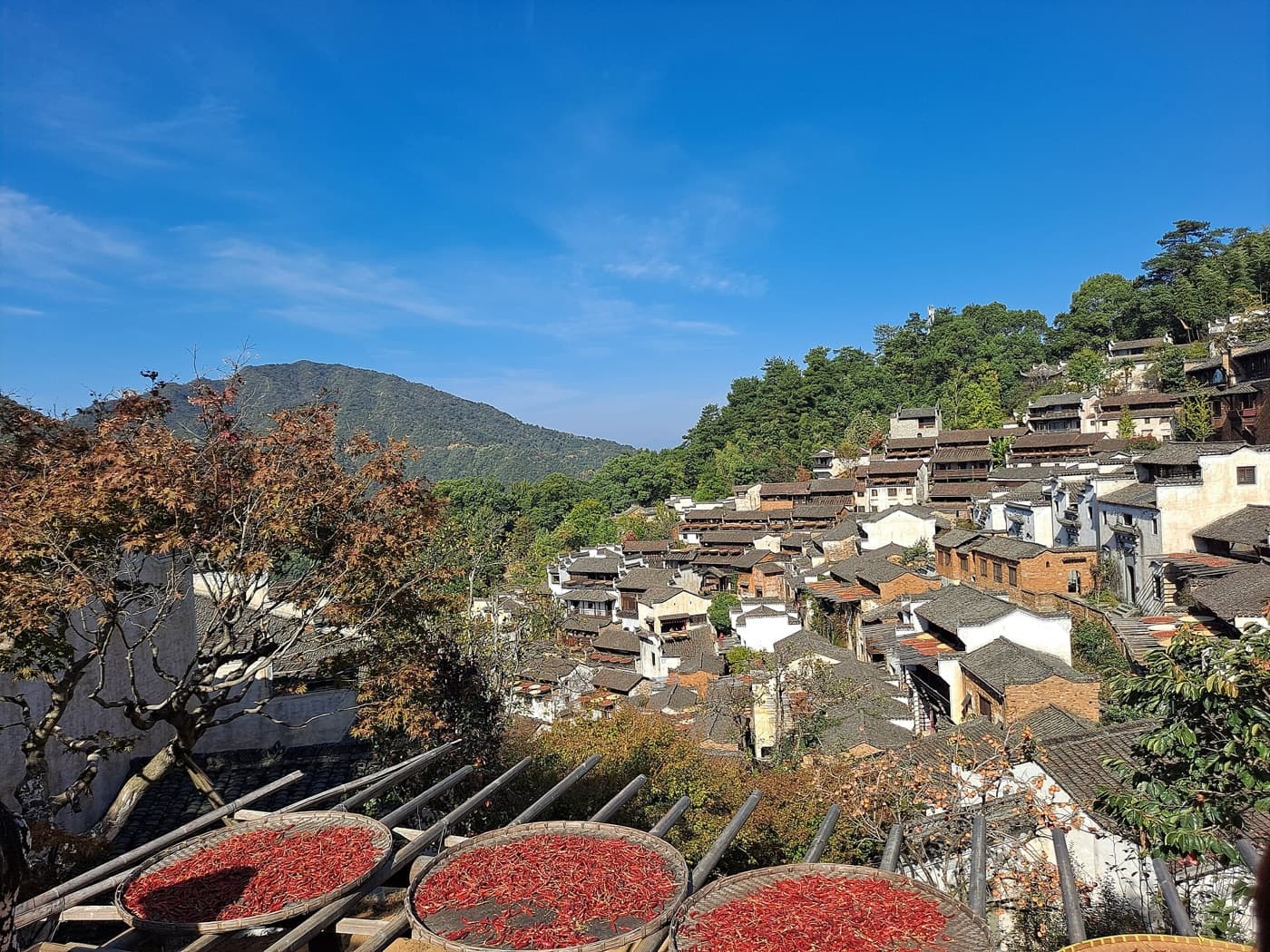
Huangling is located in the hometown of Jiang Zemin. Surrounded by mountains, its houses are packed in tiers and its terraced fields are stacked one above another, making for beautiful scenery. The Tianjie Nine Lanes (天街九巷) link the village like a jade belt, creating a moving scene reminiscent of the painting 'Along the River During the Qingming Festival.' Huangling's 'autumn drying' (晒秋) tradition is famous far and wide. Villagers spread their crops on bamboo trays on wooden racks outside their lookout windows, creating a distinctive folk landscape. In Huangling you can also experience folk activities such as walking a cable bridge, zip-lining and riding hot-air balloons.
0.5–1 day · ¥145
Wolong Valley
Wolong Valley is a pristine forest gorge. Its greatest attractions are the clusters of flying waterfalls and the emerald, crystal-clear streams, which together look like a natural ink-wash landscape painting. It is the Shangri-La from Jin Yong's novels and is ideal for escaping the summer heat. As you hike uphill, you will pass many sights. Take your time, stop often and enjoy the waterfalls. Near the summit is Konghou Bridge (箜篌桥), a suspension bridge that thrills timid visitors as they cross it.
3–4 hours · Entrance ¥55; cable car ¥50 one way, ¥100 round trip
Wangkou
Wangkou is an ancient Huizhou village, facing the undulating Xiang Mountain (象山). The long street inside the village is called Guanlu Zhengjie and is known as the 'Thousand-Year-Old Street.' The Yu Clan Ancestral Hall, built during the Qianlong era of the Qing dynasty, is well worth a visit. The hall is renowned for its fine carving and is praised as an 'Art Palace.'
1–2 hours · ¥55
Qinghua Town Rainbow Bridge
Built during the Southern Song Dynasty, this is the oldest, largest and best-preserved covered bridge in China. Many media outlets have hailed it as the most beautiful covered bridge in China, and it is one of Wuyuan’s landmarks. The famous film *Shining Red Star* was shot here.
1 hour · ¥60
Getting there & around
Getting There and Away
Wuyuan lies at the junction of Anhui, Zhejiang and Jiangxi provinces. You can reach it directly by high-speed train or long-distance bus, or fly into a nearby city's airport and continue from there.
Airports
Airports near Wuyuan include Jingdezhen Airport, Huangshan Airport and Nanchang Airport.
Railway
Wuyuan Railway Station opened officially in July 2015 and runs high-speed trains to major cities across the country, including Beijing, Shanghai, Nanjing, Lanzhou, Xiamen and Wuhan.
Road
Wuyuan's main roads include Provincial Highways 307 and 308, the Hangzhou–Ruili Expressway (Jing-Wu-Huang Expressway) and the Hangzhou–Xinjing Expressway (De-Wu Expressway). Wuyuan Bus Station is the main long-distance hub, with coaches to out-of-province cities such as Wuhan, Shanghai, Guangzhou and Hangzhou, and shuttles to cities within Jiangxi such as Nanchang, Yingtan, Jingdezhen, Shangrao and Jiujiang.
Getting Around Locally
Getting from Wuyuan county town to the individual sights is much easier. Minibuses to villages and towns depart from the new Wuyuan Bus Station in the Wuyuan Development Zone. For saving time and convenience, however, hiring a car is better. A minivan (seats six or seven) costs about ¥200–300 per day in the low season and ¥300–500 in the peak season. Bargaining is key when hiring, and routes on the eastern line are more expensive.
Wuyuan Railway Station
Wuyuan Railway Station- Address:
- Jiangwan Avenue, Wuyuan County
- Getting there:
- Take bus No. 3, 4 or 6 and get off at the railway station
Wuyuan Bus Station
Wuyuan Bus Station- Address:
- 12 Caishi Avenue
- Opening hours:
- 0793-7214948
- Getting there:
- Bus Nos. 1, 3 or 7 serve this station
Eat & drink
Local cuisine shows a clear Huizhou style, with steaming, poaching and paste-style cooking (“hu”) as its specialities. Dishes rely mainly on hu preparations, such as tofu hu and bracken hu, and on fen (powder-steamed) dishes, such as powder-steamed fish and powder-steamed pork. In fact, “hu cai” are steamed dishes, and Wuyuan is the only place in Jiangxi with this distinctive style. Eating the steamed dishes before drinking the local rice wine helps keep you from getting drunk too quickly.
Recommended Dishes
Wuyuan Fish
Recommended DishesRed carp is delicious and renowned too, so don't miss it when you are in Wuyuan. The most affordable choice is freshwater fish. The water here is clean and unpolluted, so the fish taste especially fresh. Steamed soft-shell turtle, Hebao red carp, grass carp, huangyatou and black carp are all dinner-table essentials.
Fen-Steamed Pork
Recommended DishesThis is undoubtedly a home-style dish that everyone in China knows. What sets Wuyuan's version apart is that it is steamed with cured pork rather than fresh pork, which gives it a somewhat different flavour.
Where to stay
Finding accommodation in Wuyuan is no problem, as locally run guesthouses are very common. The military guesthouse by the bridge in Ziyang Town is also an inexpensive option, and the county government guesthouse is worth considering too.
Huihe Weizhi Hotel (Wuyuan High-Speed Railway Station Branch)
Recommended AccommodationWarmly designed, with a reception desk and a guest lounge on the ground floor. The décor has a distinctly Jiangnan flavour.
- Address:
- 39 Wenbo Road, Wuyuan County
- Phone:
- 0793-7479888
Shopping
Wuyuan is known for “red, green, black and white”, with each colour representing a local speciality.
Jialu Paper Umbrellas
Jialu paper umbrellas come in vivid colours, exquisite patterns and many different sizes. Even as a craft object alone, they are worth buying.
Red
Hebao Red Carp: Wuyuan's Hebao red carp has a vivid red colour and a purse-like shape, with tender flesh. It is a nationally recognised high-quality freshwater fish. Legend has it that a Wuyuan native returning home in glory brought them from a pond in the Imperial Garden.
Green
Wuyuan Green Tea: pale green leaves and a rich, fragrant taste. It was already recorded by Lu Yu in the Tang dynasty's “Classic of Tea”.
Black
Longwei Inkstone: famed for its “bronze-like ring, iron-like colour, firm and smooth nature, and fine ink-holding ability.”
White
Jiangwan Snow Pear: crisp, juicy, delicious and free of grit.
Day trips & beyond
Source: China Self-Guided Travel 2025 (《中国自助游》, Tianjin Science & Technology Press, Aug 2024), pp. 1479–1490. Translated from the Chinese edition; names and prices follow the guidebook. · Plain text version