Eastern Gansu travel guide
陇东
Fuxi, the first of the Three Sovereigns and Five Emperors, is said to be from Tianshui. According to legend, his mother stepped on a giant footprint at Leize and became pregnant, giving birth to Fuxi.…
8 places · In the guidebook: pages 771–782

Eastern Gansu, Gansu Province · AI illustration for China Trip
Quick itinerary
Eastern Gansu in 4 days
- Day 1
- Fuxi Temple→
- Yuquan Taoist Temple→
- Nanguo Temple
- Day 2
- Maijishan Grottoes→
- Jieting Ancient Town (hot spring, accommodation)
- Day 3
- Jieting Ancient Town→
- Tianshui→
- Pingliang
- Day 4
The feel of the place
- Hometown of Xihuang
- Fuxi, the first of the Three Sovereigns and Five Emperors, is said to be from Tianshui. According to legend, his mother stepped on a giant footprint at Leize and became pregnant, giving birth to Fuxi. The more historical Fuxi was the chief of a primitive tribe, whose lifetime achievements include creating writing, teaching people fishing and hunting, promoting monogamous marriage, and devising the Bagua diagram.
- Misty Rain over Maiji
- Tianshui lies on the edge of the Loess Plateau, where the landscape is mostly loess hillsides, yet for more than 100 kilometres around Maijishan the land is shaded by lush trees and scenically beautiful. The Maijishan Grottoes also differ from other grottoes in Gansu: countless craftsmen carved Buddha statues and cave shrines across the entire mountain, and the kindly Buddhas look out over a boundless, misty landscape, an earthly paradise.
Fuxi Temple
“If you come to Tianshui and don't visit Fuxi Temple, it is as if you haven't really been to Tianshui.” Some local villagers say the real Fuxi Temple is on Guatai Mountain in Weinan Town, 25 kilometres from the city centre. In ancient times, it took hours to reach Guatai Mountain on foot or on horseback, so to make it convenient for officials and wealthy people in the city to make offerings to Fuxi, a Fuxi Temple was built in the city during the Ming dynasty.
tip: The hot springs at Jieting Ancient Town, near Maijishan, are very famous. They are rich in 19 trace elements beneficial to the human body, including silicon, lithium, boron, strontium, molybdenum and cobalt. It is said that after bathing, the skin feels smooth and soft, body and mind feel refreshed, and there are some health-maintaining benefits.
Things to see

Maijishan Grottoes
2–3 hours · ¥80; tickets for special-protection caves ¥100–180
The Maiji Mountain Grottoes were first carved during the Later Qin of the Sixteen Kingdoms period and were repaired and expanded by successive dynasties. There are 194 caves, more than 7,000 clay and stone sculptures, and over 1,300 square metres of murals. The caves are concentrated on cliffs 20–80 metres above the valley floor and linked by plank walkways. Because of the damp climate, few murals have survived, but the sculptures rival those of the Mogao Caves. Caves are also found at Xianren Cliff, Stone Gate and Qu Xi scenic areas, though these are mainly known for their natural scenery.
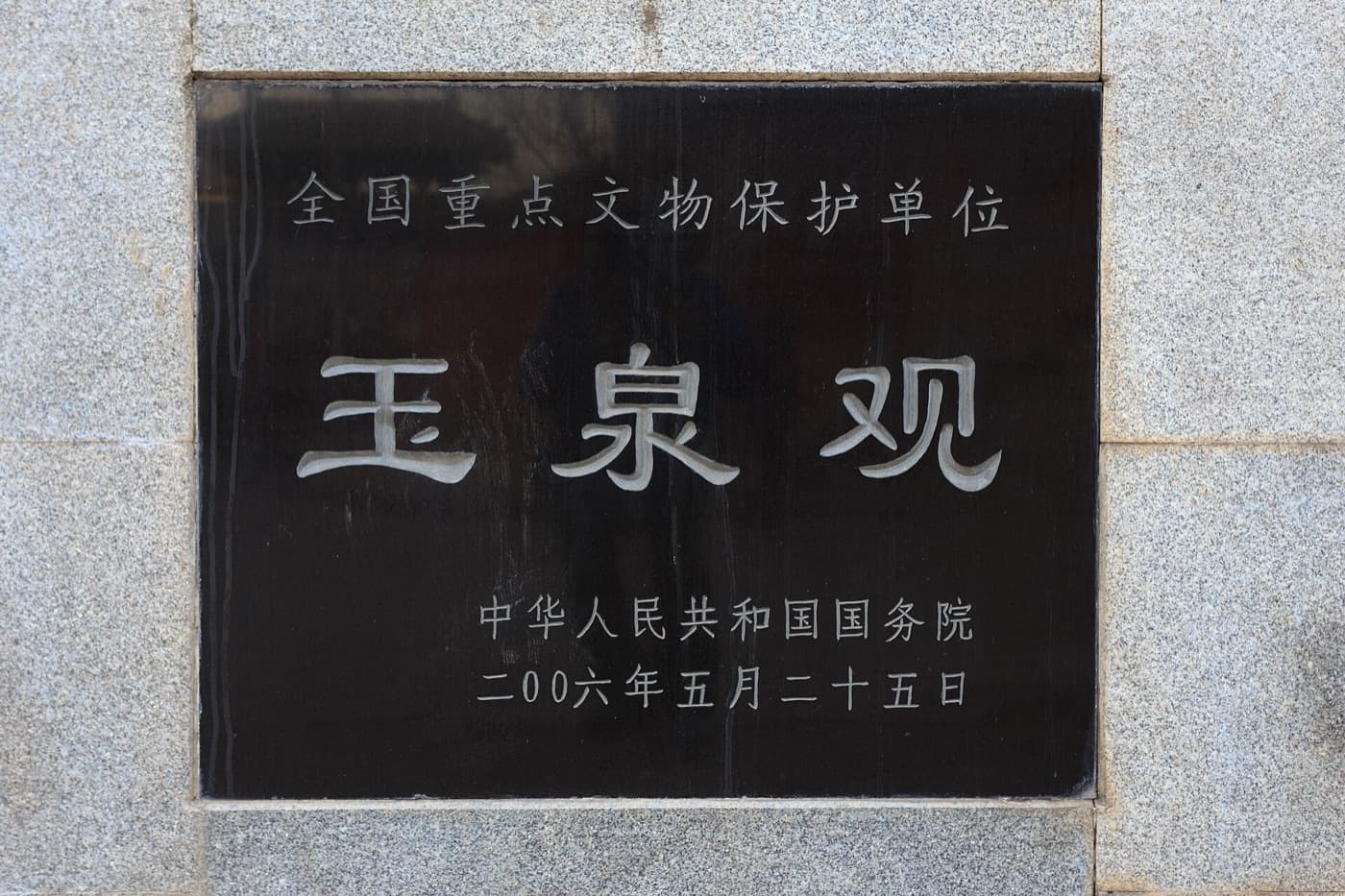
Yuquan Taoist Temple Scenic Area
1–3 hours · ¥20
Built in 1299, this is the Taoist sacred site of Tianshui. It sits at the foot of Tianjing Mountain, north of the city centre, and takes its name from a clear spring (Yuquan, "Jade Spring") on the mountain. Every year on the 9th day of the first lunar month, the temple fair known locally as "Chaoguan" (Pilgrimage to the Temple) takes place.
Tianshui Fuxi Temple Scenic Area
First built in the Yuan dynasty, this large temple complex is laid out across three courtyards on Guanfu West Road. It features ancient cypress trees and old residences, and the statue of Fuxi in the main hall was re-sculpted in recent years. Every year on the 16th day of the fifth lunar month, the Fuxi Festival is held here.
2–3 hours · ¥20
Wushan Water Curtain Cave, Tianshui
Water trickles down the cave year-round, and on rainy days water cascades from the eaves like a curtain, which gives the cave its name. The complex includes Lashao Temple, the Thousand Buddha Caves, Xiansheng Pool and the Water Curtain Cave. It is the second most important grotto complex after the Maiji Mountain Grottoes. The scenic area is home to the Lashao Temple Buddha, an open-air cliff relief said to be the largest of its kind in Asia. More than a hundred statues from successive dynasties and over 2,000 square metres of murals survive here, making it well worth a visit.
1–3 hours · Admission ¥30; sightseeing shuttle round trip ¥10
Kongtong Mountain
Kongtong Mountain, one of the Twelve Immortal Mountains of Taoism, lies on the eastern foot of the Liupan Mountains, 15 km southwest of Pingliang. Thirty-odd pavilions and temples stand on the summit, divided into five platforms: east, west, south, north and central. Kongtong Reservoir lies at the foot of the mountain. From the peak, the Loess Plateau stretches out below, while pines and cypresses frame the temples and towers, and incense smoke and mist drift through the air. Emperors Qin Shi Huang and Han Wudi both climbed Kongtong Mountain to seek the wisdom of immortals, following the example of the Yellow Emperor.
0.5–1 day · Peak season ¥110; off-season ¥55
Yunya Temple Scenic Area
Yunya Temple sits among steep, dramatic peaks that vie for attention, known as the "Four Platforms and Sixteen Peaks." Below lies Zhulin Temple Reservoir, its calm waters mirroring the sky. Sunlight, water, clouds and peaks reflect and complement one another. The Yunya Temple Grottoes, carved into the sheer cliffs of the main peak, are known as the "culmination of late Chinese cave art," and hold significant historical and artistic value for the study of late Chinese grottoes and Buddhist art.
0.5 day · ¥55
Xianren Cliff
Located 15 km from the Maiji Mountain Grottoes, Xianren Cliff is a scenic spot where Buddhism, Taoism and Confucianism coexist. It comprises three cliffs, five peaks and six temples. The three cliffs are East, West and South. The five peaks are Jade Emperor, Canopy, Pearl Offering, East Cliff and West Cliff. The six temples are Muglian, Stone Lotus, Iron Lotus, Flower Lotus, Water Lotus and Lingying. Majestic mountains, clear waters, lush trees and scattered wildflowers complement one another, making you feel as if you have stepped into a fairyland.
1–3 hours · ¥40
Gangu Daxiangshan Scenic Area
This area offers beautiful scenery and steep mountains covered with many pines and junipers, and the air is filled with the fragrance of fragrant osmanthus. Pavilions and towers are built into the hillside, and carved beams and painted rafters peek through the green foliage, leaving visitors spoilt for choice. The highlight is the large cave on the mountain, which houses a stone-core clay Buddha statue, lifelike in expression and grand in scale.
¥30
Getting there & around
Arrival and Departure
Tianshui is divided into two parts, Qinzhou District and Maiji District, which are 20 kilometres apart. The railway station is in Maiji District, but the commercial centre, sights such as Fuxi Temple, and the Tianshui Bus Terminal (天水汽车总站) are all in Qinzhou District.
Pingliang sits at the junction of Gansu, Shaanxi and Ningxia, so it is quite convenient to reach neighbouring provinces and cities from here. After a day trip to Kongtong Mountain, you can simply carry on with your journey.
Air
Tianshui Airport is 12 kilometres outside the city and has flights to Xi'an, Lanzhou, Nanjing, Hangzhou and other destinations. Shuttle buses run from the airport to the city; a taxi costs around ¥30.
Rail
All trains to Lanzhou stop at Tianshui, so making Tianshui the start and end point of your Gansu trip is a wise choice.
Pingliang is a must-pass on the way from Xi'an to Yinchuan, so almost all trains from southern China to Yinchuan stop at Pingliang. Bus No. 1 runs from the west of the city to the north railway station.
Road
Tianshui has direct buses to provincial destinations including Lanzhou, Wuwei, Baiyin, Dingxi, Linxia, Pingliang, Xifeng and Qingyang, and to destinations outside the province such as Xining, Yinchuan, Xi'an, Hanzhong and Luoyang. There are also chartered tourist vehicles to Kongtong Mountain in Pingliang, Jiuzhaigou in Sichuan, and other places.
Road transport is the most convenient way to get in and out of Pingliang. The city has two long-distance bus stations, each handling traffic in one direction, east or west.
Bus No. 6 from the square in front of Tianshui Railway Station (天水站) goes to the urban area of Qinzhou District. The fare is ¥2, the journey takes about 40 minutes, and buses run every 15 minutes. Local buses also go to scenic areas such as Maijishan, Xianrenya and Shimenshan, for about ¥1.
Pingliang has 20 city bus routes, along with 5 special tourist lines serving the main sights.
Airport Information
Airport Information- Phone:
- 0938-2652000
Tianshui Railway Station (天水站)
Rail- Address:
- No. 2 East Yima Road, Maiji District
Pingliang Railway Station (平凉站)
Rail- Address:
- Urban area of Kongtong District
Tianshui Bus Terminal (天水汽车总站)
Tianshui Bus Terminal- Address:
- No. 46 East Taishan Road, Qinzhou District
Eat & drink
Mouth-numbing, fragrant and spicy, Tianshui malatang has become Gansu's latest food superstar. Even an unassuming little malatang shop in Tianshui may hide a feast, with generous portions at honest prices. Watching the ingredients you have picked out cook in the bubbling pot, you are sure to be drooling. Once they are fished out, they are topped with some of the broth and garlic water, then sprinkled with seasonings, and of course no bowl is complete without that soul-giving spoonful of glossy, bright-red chilli oil.
Mianpi
Mianpi is Tianshui's most famous local snack. Although many places now serve mianpi, authentic Tianshui mianpi is a must-try. Almost every street and lane in Tianshui has small mianpi eateries and stalls. Golden, translucent mianpi sheets, seasoned with chilli oil, refined salt, soy sauce, garlic paste, mustard, black vinegar, sesame paste and a small pinch of greens, are truly mouth-watering.
Steamed Damo
Locals who steam damo (large steamed buns) like to add eight jujubes, said to imitate the Bagua.
Where to stay
Accommodation in Tianshui is very convenient, whether in the city centre or in the county towns; it is easy to find somewhere to stay. Generally, around ¥100 will get you a very decent standard room. Staying in Qinzhou District is recommended, since most of Tianshui's main sights are located there, making getting around more convenient.
Nightlife
The area around the central square of Qinzhou District in Tianshui is a commercial zone, modern and bustling. Here you can shop and eat, and on the northeast side of the square there is a large night market with all kinds of Gansu-style noodles and snacks.
Source: China Self-Guided Travel 2025 (《中国自助游》, Tianjin Science & Technology Press, Aug 2024), pp. 771–782. Translated from the Chinese edition; names and prices follow the guidebook. · Plain text version