Shiniuzhai
The stronghold takes its name from a huge boulder on its western side that resembles a yellow ox ("shiniu" means stone ox). Shiniuzhai has steep, perilous terrain, with cliffs rising in ranks.…
Shiniuzhai, Yueyang
Key facts
- Admission
- Combination tickets range from ¥148 to ¥248, depending on the package
- Opening hours
- 08:00-17:00 (year-round)
- Time needed
- 3–5 hours
- Getting there
- From Changsha or Yueyang, take a long-distance bus bound for Changshou or Pingjiang, and get off at Shiniu Stronghold on the way
- Guidebook rating
- 4 / 5
From China Self Guided Travel 2025, page 1953. Open in Google Maps
About Shiniuzhai
The stronghold takes its name from a huge boulder on its western side that resembles a yellow ox ("shiniu" means stone ox). Shiniuzhai has steep, perilous terrain, with cliffs rising in ranks. Its scenery is unusual. The sights inside the stronghold are known for their dramatic, perilous character and can be summed up as: "One Ox, Two Turtles, Three Passes; Four Bridges, Five Villages, Six Ravines; Seven Wonders, Eight Temples; a hundred and eight cliffs of boundless scenery." Especially rare is the well-preserved ancient city wall, more than 2,000 metres long. Shiniuzhai enjoys the reputation of being the "First Stronghold Under Heaven."
Frequently asked questions
How much does Shiniuzhai cost?
Admission to Shiniuzhai is Combination tickets range from ¥148 to ¥248, depending on the package, as listed in the 2025 guidebook. Prices can change; check the official channel before you go.
What are the opening hours of Shiniuzhai?
Shiniuzhai is open 08:00-17:00 (year-round).
How do I get to Shiniuzhai?
From Changsha or Yueyang, take a long-distance bus bound for Changshou or Pingjiang, and get off at Shiniu Stronghold on the way
How long should I spend at Shiniuzhai?
Plan on 3–5 hours for Shiniuzhai.
Where is Shiniuzhai?
Shiniuzhai is in Yueyang, Hunan Province, in the Central China of China. Xinyi Village, Shiniuzhai Town, Pingjiang County, Yueyang City
More places in Yueyang
Dongting Lake and Junshan Island
The vast expanse of Dongting Lake is truly spectacular. Visitors who enjoy the rain and quiet reflection may visit Yueyang Tower from mid-April to early June. This is the rainy season, and sitting quietly in the tower, listening to the wind and rain and watching the churning waves, while reading the "Record of Yueyang Tower" inside, creates a mood that words cannot fully capture. The lake beneath Yueyang Tower has been known since ancient times as "Eight Hundred Li Dongting." Although its area is now about half of what it once was, it is still China's second-largest freshwater lake, with misty waves stretching to the horizon and water meeting sky. It fits the description "it holds distant mountains and swallows the Yangtze, vast and rolling, without end." The most legendary sites on Junshan are the Tomb of the Two Consorts and Liuyi Well. According to legend, E'huang and Nüying wept tears onto the bamboo here, which is why the island is also famous for its many varieties of bamboo. Liuyi Well is said to be the entrance through which Liu Yi, in folk legend, travelled to the Dragon Palace of Dongting to look for the Dragon Princess.
Junshan Island ¥78 · 2–4 hours
Yueyang Tower
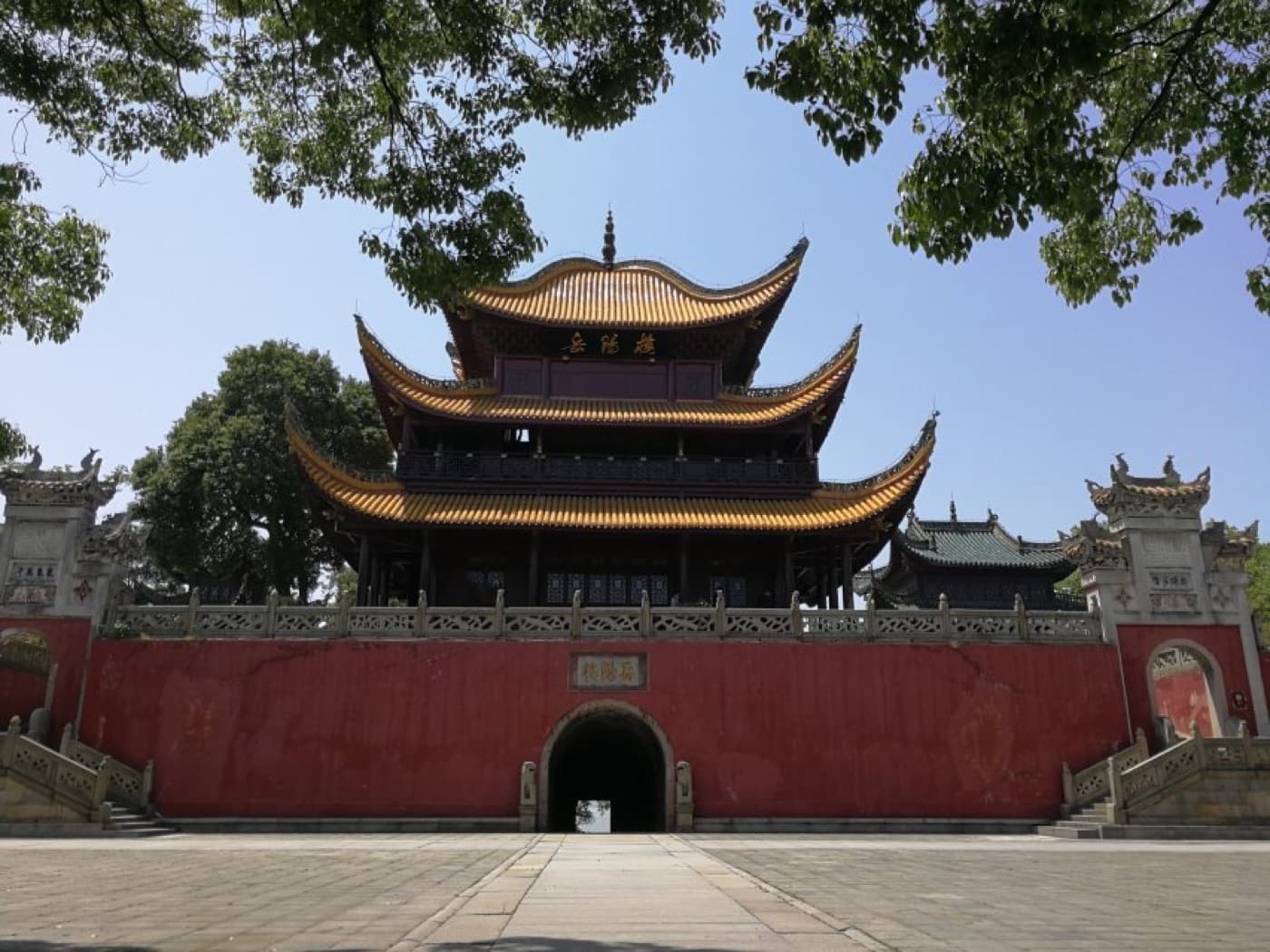
Fan Zhongyan's famous "Record of Yueyang Tower" has done a great deal to promote the tower. Yueyang Tower stands on the shore of Dongting Lake. To the north it looks out over the eastward-flowing Yangtze River, and to the south it overlooks the Three Xiang and Four Rivers. Its setting, with mountains and water on either side, feels open and expansive. Together with the Yellow Crane Tower in Wuhan and the Tengwang Pavilion in Nanchang, it is known as one of the "Three Great Towers of the Jiangnan Region."
¥70 · 2–3 hours
Quzi Temple
While he was exiled, Qu Yuan once lived on Yusi Mountain by the Miluo River. After Qu Yuan drowned himself in the Miluo River, local people built Quzi Temple in his memory. The temple that stands today was rebuilt in the Qing dynasty and largely reflects Qing architectural style. It has three halls, with courtyards at the front, back, left and right. In the centre is a cinnabar pond with a large flower platform, where a golden osmanthus tree more than 300 years old grows. The corridor walls are inlaid with many stone tablets carved with poems, verses and rhapsodies by later visitors paying their respects.
¥55 · 1–2 hours