Nuohei Village
For generations, the people of Nuohei Village have built their homes from layered stone quarried from the mountains, earning it the nickname “Stone Village.” The villagers are Yi people,…
Nuohei Village, Kunming
Key facts
- Admission
- Free
- Opening hours
- Open all day
- Time needed
- 3–4 hours
- Getting there
- Take a minibus from Kunming East Bus Station to Shilin County seat, then transfer to a local minivan to Nuohei Village; if driving, navigate to Nuohei Village
- By car
- Route 1: Take the Shankun Expressway and exit at Shilin, then follow Jiushi'a Road. Route 2: Take the Fukun Line → Xiuhe Line → Jiushi'a Road
- Guidebook rating
- 4 / 5
From China Self Guided Travel 2025, page 208. Open in Google Maps
About Nuohei Village
For generations, the people of Nuohei Village have built their homes from layered stone quarried from the mountains, earning it the nickname “Stone Village.” The villagers are Yi people, and during the Torch Festival you can join the young Ashima and Ahei for a bonfire celebration.
Frequently asked questions
How much does Nuohei Village cost?
Admission to Nuohei Village is Free, as listed in the 2025 guidebook. Prices can change; check the official channel before you go.
What are the opening hours of Nuohei Village?
Nuohei Village is open Open all day.
How do I get to Nuohei Village?
Take a minibus from Kunming East Bus Station to Shilin County seat, then transfer to a local minivan to Nuohei Village; if driving, navigate to Nuohei Village
How long should I spend at Nuohei Village?
Plan on 3–4 hours for Nuohei Village.
Where is Nuohei Village?
Nuohei Village is in Kunming, Yunnan Province, in the Southwest of China. Nuohei Road, Shilin Yi Autonomous County, Kunming
More places in Kunming

Jiuxiang Scenic Area
Jiuxiang Scenic Area is famous for its karst caves and is known as the “Land of Caves”. The cave system formed from ancient dolomite some 600 million years old. Inside are nine major areas, including Jinghun Gorge, Yincui Gorge, Guhe Cave, Shennü Palace and Yijia Village. Jinghun Gorge is the largest gorge inside a cave in China, and Yincui Gorge is known as the “Lovers' Valley”, where young Yi men and women of Jiuxiang once sang love songs to each other. The area has also served as a filming location for several films, including *The Myth* and *Little Big Soldier*.
¥60; Dieheng Bridge Great Cableway ¥120 (round trip) · 2–3 hours

Stone Forest Scenic Area
Stone Forest boasts the most extraordinary karst landscape in the world, attracting countless visitors from China and abroad, and is hailed as the “First Wonder Under Heaven”. “Scenery of Stone Forest” is the most representative attraction here. Within the scenic area are “animal-shaped” rocks such as Tang Monk Rock, Monkey King Rock and Ashima, each with its own beautiful legend.
¥130 · 3 hours or more
Dongchuan Red Land
This is regarded as a cultural and natural landscape rivaling Brazil's red soil, and one of the most magnificent red-earth landscapes in the world. For thousands of years, working people have cultivated the red soil, growing highland barley (青稞), wheat, potatoes, rapeseed and other crops. Over time, it has formed a dazzling, colorful panorama. Throughout the year, as different crops are sown and ripen, the land reveals a different spectacular palette.
Free · 3+ hours
Yuanyang Hani Rice Terraces Scenic Area
Hailed as 'the most beautiful mountain carving in China', it is vast in scale, comprising Bada Scenic Area, Laohuzui Scenic Area, Duoyishu Scenic Area, Qingkou Scenic Area and more. Visitors come to watch the magnificent sunrises and sunsets over the terraces and to experience the distinctive charm of Hani villages. At Duoyishu, golden clouds are often wrapped in mist, and at sunrise they form dazzling glowing vistas, making it one of photographers' favorite scenes.
¥70 · 3+ hours
Bamei Shangri-La Scenic Area
Amid towering mountains, you paddle a dugout canoe through a dark natural water cave and emerge into a fairy-tale village: Bamei. Bamei people have lived for generations in seclusion, where village life of farming and weaving, with chickens and dogs within earshot of one another, embodies the 'Peach Blossom Spring' idyll described by the poet Tao Yuanming. Zhuang traditions such as sacrificial rites, antiphonal singing and the nighttime sowing of the sacred field have retained their original character. Signature dishes include five-colored rice and Bashang chicken (岜夯鸡), vivid in color and delicious in flavor.
Combo ticket ¥180 (includes admission, sightseeing shuttle and boat ride) · 1–2 days
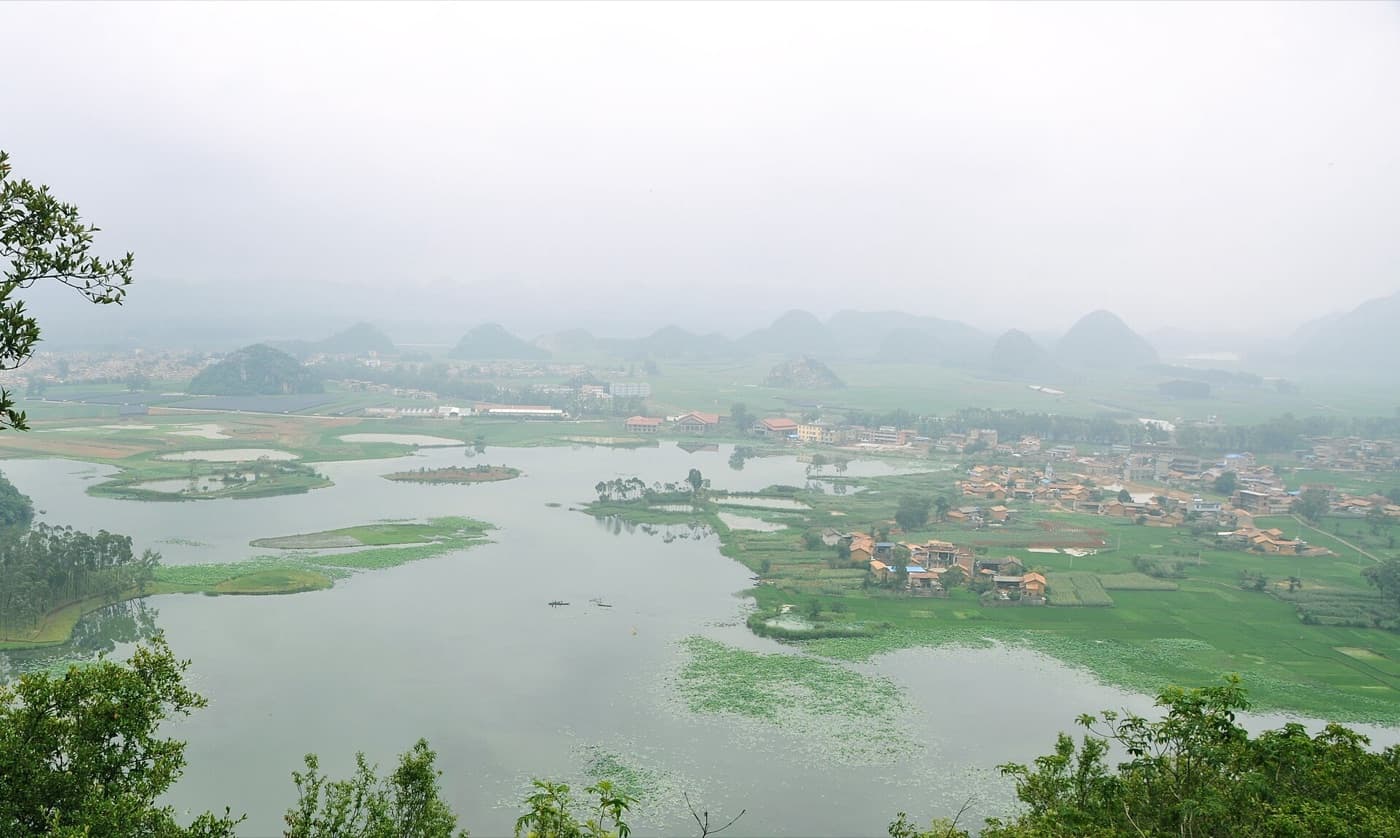
Puzhehei
Puzhehei Lake, whose name in the Yi language means 'a pond rich in fish and shrimp'. Islands in the lake include Luyuan Island (鹭鸳岛), Pearl Island and Lotus Leaf Island. Gliding across the water, you see mountains within the lake and lake within the mountains. From June to September, tens of thousands of mu of red and white lotus flowers sway across the lake, and moonlight shimmers on the rippling water, giving the lakescape a special allure. Puzhehei was also the filming location for Hunan TV's parent-child show Where Are We Going, Dad? and the TV series Eternal Love (三生三世十里桃花).
Circuit sightseeing shuttle ¥92 per day; Swan Lake ¥85; Lotus Breeze Night Light ¥198; Qingqiu Mural Wall ¥128; boat tickets ¥80–260 depending on type · 1–2 days