Kizil Caves
One of China's four great Buddhist cave complexes, located more than 70 kilometres northwest of Kuqa, Kizil is the most important stop on any Kuqa itinerary.…
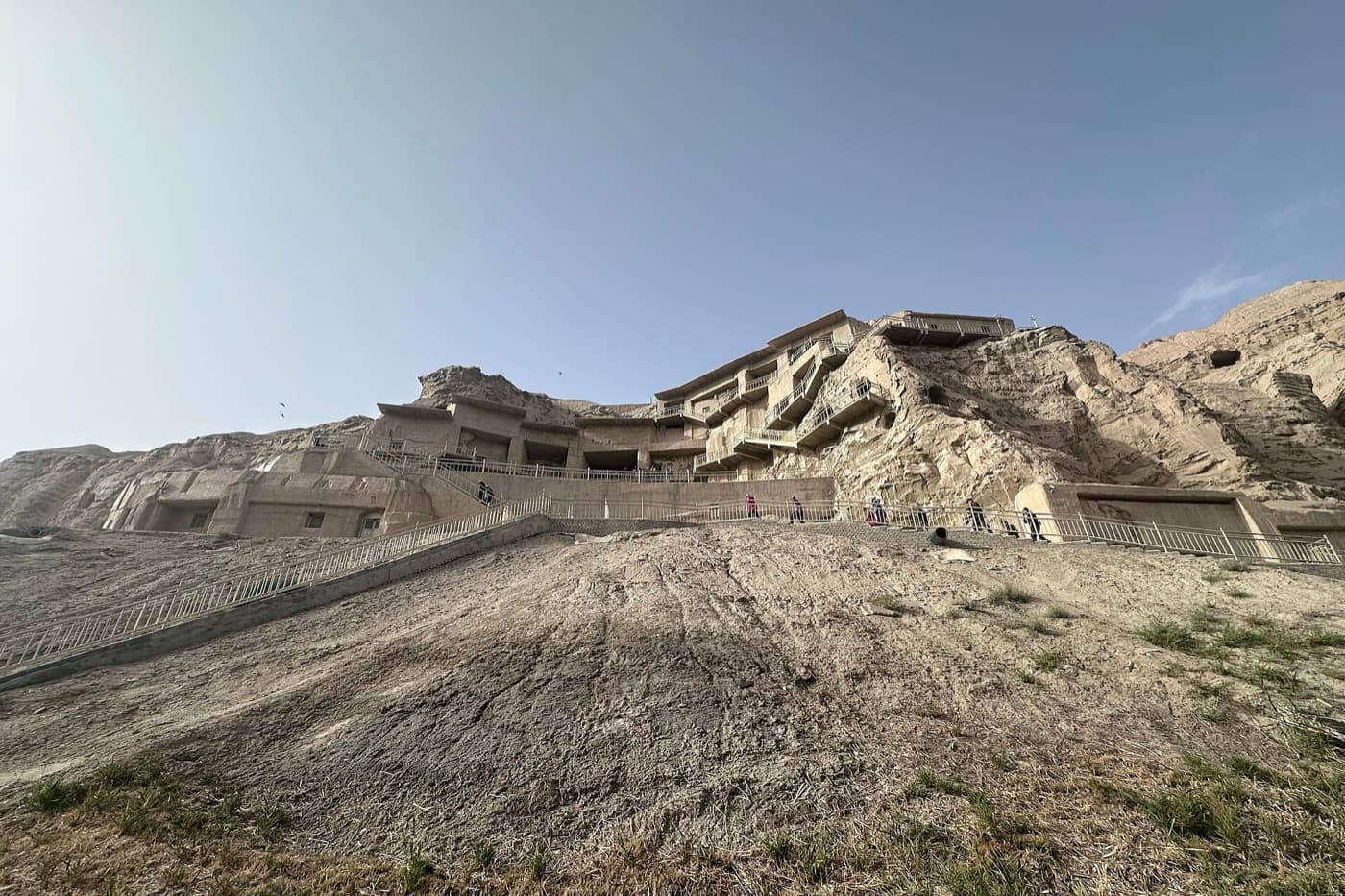
Kizil Caves, Kuqa · HaziiDozen · CC BY-SA 4.0 · Wikimedia Commons
Key facts
- Admission
- ¥70
- Opening hours
- 10:00–18:00 (winter), 9:30–19:00 (summer), closed on Mondays
- Time needed
- 1–3 hours
- Getting there
- Hire a car from Kuqa; the fare is over ¥150.
- Guidebook rating
- 4 / 5
From China Self Guided Travel 2025, page 885. Open in Google Maps
About Kizil Caves
One of China's four great Buddhist cave complexes, located more than 70 kilometres northwest of Kuqa, Kizil is the most important stop on any Kuqa itinerary.
The caves were first excavated in the 3rd century, at the end of the Eastern Han dynasty. Between the 5th and 7th centuries they were at the height of their prosperity: at that time the Qiuci Kingdom had a population of over 100,000, and more than 10,000 monks practised in the Thousand Buddha Caves. By the 8th century, war and the arrival of other religions had silenced the sound of chisels carving the caves.
The caves are carved into the cliffs on the north bank of the Muzat River valley. There are 236 caves in total, of which 135 are relatively well preserved and 80 contain murals. This makes it the earliest and largest cave complex in China. The surviving murals cover more than 10,000 square metres and are the most precious treasure of the Kizil Thousand Buddha Caves. Because Qiuci followed Hinayana Buddhism, its murals differ in style from those of other regions, featuring the mysterious diamond-shaped patterns often seen here, which are said to be a hallmark of Qiuci cave art.
Frequently asked questions
How much does Kizil Caves cost?
Admission to Kizil Caves is ¥70, as listed in the 2025 guidebook. Prices can change; check the official channel before you go.
What are the opening hours of Kizil Caves?
Kizil Caves is open 10:00–18:00 (winter), 9:30–19:00 (summer), closed on Mondays.
How do I get to Kizil Caves?
Hire a car from Kuqa; the fare is over ¥150.
How long should I spend at Kizil Caves?
Plan on 1–3 hours for Kizil Caves.
Where is Kizil Caves?
Kizil Caves is in Kuqa, Xinjiang Uygur Autonomous Region, in the Northwest of China.
More places in Kuqa
Big and Small Dragon Lakes
The Big and Small Dragon Lakes lie about 120 kilometres north-northeast of Kuqa Station. The Big Dragon Lake is an alpine lake formed from Tianshan snowmelt. Its broad waters are crystal clear, like a mirror. Surrounded by mountains, with snow-capped peaks, spruce-clad slopes and green meadows dotted with herds of cattle and sheep, it is breathtaking. Legend has it that the Queen Mother of the West once bathed here. Four kilometres away is the Small Dragon Lake, which sparkles like a flawless gemstone and echoes its larger sibling. The two lakes are famed for their scenic beauty. When summer arrives and gentle rain falls, the green spruces and grasses on the hillsides, set against the snowy peaks, form layer upon layer of beauty that refreshes the spirit and makes you linger.
¥20 · 0.5–2 hours
Kuqa Palace
Kuqa, known in ancient times as Qiuci, was a key hub on the Silk Road and the political, economic and cultural centre of the ancient Western Regions. This glorious history has left Kuqa with many precious ancient sites and exquisite cultural relics. Kuqa Palace was first built in 1759. Twelve Kuqa kings, all enfeoffed by the Qing government, lived here in succession, and its architecture blends Uyghur, Han and other ethnic cultural characteristics. The palace was home to the last prince and princess in China. Sadly, the old prince has passed away, but the princess still lives in the palace. In many ways, Kuqa Palace is a microcosm of Qiuci culture. Here you can appreciate the profound depth of that culture, learn about the rise and fall of the Kuqa royal family, and trace the socio-economic development of Kuqa.
¥55 · 2 hours
Kuqa Grand Mosque
The Kuqa Grand Mosque is said to have been founded in the 16th century, when a leader of Islam in Xinjiang travelled from Kashgar to Kuqa to preach. The complex comprises a prayer hall, a minaret and the Moon-Watching Tower, and it features a rich Uyghur architectural style, with space for several thousand worshippers. Climb the minaret for a view over the whole city. The carvings, murals and calligraphy inside the prayer hall are exquisitely elaborate.
¥15 · 1–2 hours
Kucha (Qiuci) Ancient City Ruins
The ancient Qiuci Kingdom was the political centre of the Western Regions and a vital waypoint on the Silk Road, linking East and West. Today, a millennium of history has washed away the city's former splendour, leaving behind a desolate, faintly recognisable ruin. Only three walls of the old city can still be made out; the west wall has vanished entirely.
0.5–1 hour
Tianshan Mysterious Grand Canyon
The Tianshan Mysterious Grand Canyon is known as one of the ten most beautiful canyons in China. Located in Aiyi Township (阿艾乡), Kuqa City, on the southern slopes of the Tianshan Mountains in Xinjiang, it is made up of huge red-brown rock formations, which local people call “Kezier Ya,” meaning “red cliff” in Uyghur. Although the canyon lies in arid inland terrain covered in fine sand, clear springs gurgle through it, their waters flowing in and out of sight, a true marvel. On a cliff about 1.4 kilometres from the canyon mouth, a deep cave has been found; its walls bear remnants of murals and Chinese characters, adding a sense of mystery to the canyon.
¥45 · 2–3 hours