Giant Banyan Tree
This is the filming location of the film Liu Sanjie, and it is famous far and wide for a thousand-year-old banyan that grows here.…
Giant Banyan Tree, Yangshuo
Key facts
- Admission
- Combined ticket for Giant Banyan Tree and Moon Hill: ¥26
- Opening hours
- 8:00—17:30
- Time needed
- 1–2 hours
- Getting there
- Cycle for 20 minutes along the road from Yangshuo towards Lipu, crossing Gongnong Bridge to arrive
- Guidebook rating
- 4 / 5
From China Self Guided Travel 2025, page 2445. Open in Google Maps
About Giant Banyan Tree
This is the filming location of the film Liu Sanjie, and it is famous far and wide for a thousand-year-old banyan that grows here. The Giant Banyan Tree stands 17 metres tall and is about 1,500 years old. Its roots twist and intertwine, so a single tree forms a whole forest, rising from the earth like a huge mushroom cloud.
Frequently asked questions
How much does Giant Banyan Tree cost?
Admission to Giant Banyan Tree is Combined ticket for Giant Banyan Tree and Moon Hill: ¥26, as listed in the 2025 guidebook. Prices can change; check the official channel before you go.
What are the opening hours of Giant Banyan Tree?
Giant Banyan Tree is open 8:00—17:30.
How do I get to Giant Banyan Tree?
Cycle for 20 minutes along the road from Yangshuo towards Lipu, crossing Gongnong Bridge to arrive
How long should I spend at Giant Banyan Tree?
Plan on 1–2 hours for Giant Banyan Tree.
Where is Giant Banyan Tree?
Giant Banyan Tree is in Yangshuo, Guangxi Zhuang Autonomous Region, in the South China of China. Giant Banyan Tree Scenic Area, Guiyang Road, Yangshuo County
More places in Yangshuo

Impression Liu Sanjie
The large-scale live-action show “Impression Liu Sanjie” is the core project of the Yangshuo “Jinxiu Lijiang · Liu Sanjie Song Fair” scenic area. Directed by renowned Chinese director Zhang Yimou as chief director, it brings together the Li River landscape, the culture of Guangxi's ethnic minorities and the work of leading Chinese artists. It is China's first live-action landscape show of a completely new concept.
¥278–888 · 1–2 hours
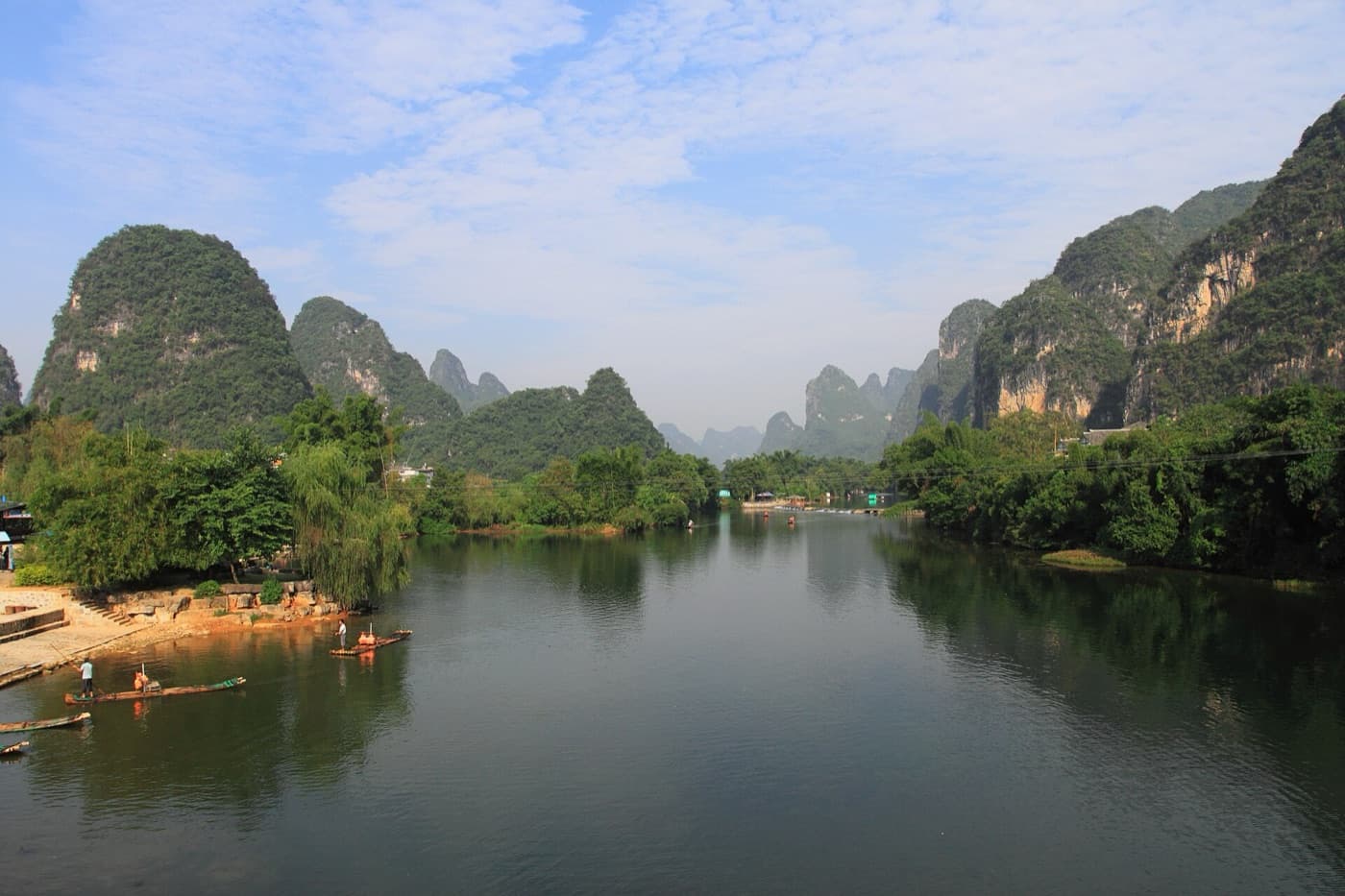
Yulong River
Yulong River is known as the “Little Li River.” Visitors remember most the sense of stillness here, as if every movement might disturb the surrounding beauty. Unlike the Li River rafting, the bamboo rafts here have no motors and are poled entirely by hand, and there are noticeably fewer rafters than on the Li River, so the experience feels authentic and largely free of commercial bustle. It also differs from the thrills and danger of Longjing River; here the pursuit is tranquility, free from distraction.
Rafting charged by section, ¥45–358 · 2–5 hours
Longjing River Rafting
This rafting trip suits young people best. Its thrills and dangers have earned high praise, and it is known as “the first rafting ride under heaven for brave souls.” The route includes about five major drops, all extremely dangerous and nearly vertical. Rubber rafts and riders plunge down the rapids, so it is less rafting than falling, and occasionally boats even capsize. Since you will get completely soaked, it is only suitable for summer.
¥228 (includes the Yangshuo shuttle bus ticket) · 2–4 hours
West Street (Xijie)
West Street is not large — just a 200-metre stone-paved pedestrian street — yet this small patch of land is world-famous. Foreigners are everywhere on West Street, offering plenty of chances to practise your English listening. It is best known for its bars, which are full of exotic flavour. Some feel it is too bustling and noisy, and that commercialisation has developed too rapidly; opinions on this naturally vary.
Free · 1–3 hours
Ten-Mile Gallery
From Yangshuo county town, head south along Guili Highway all the way to the banks of the Tianjia River. The road is lovely throughout, with pastoral scenery as poetic as a painting, which is why it is known as the Ten-Mile Gallery. Many attractions line this route, including the Giant Banyan Tree, Moon Hill and Butterfly Spring, making it a must-visit in Yangshuo. Most visitors rent a bicycle to ride there, and the scenery is sure not to disappoint.
Free; individual sights along the way require separate tickets · 2 hours
Huangyao Ancient Town
The filming location for *Tea Is Strong in My Hometown*. The town is known for its “six manys”: many mountains, waters, caves and rocks; many pavilions and towers; many temples, shrines and ancestral halls; many ancestral halls; many ancient trees; and many couplets and plaques. All the streets are paved with black flagstones, and the buildings are arranged in a nine-palace, eight-trigram layout. Most houses are two-storey brick-and-tile structures with exquisite craftsmanship. Must-see sights include the flagstone streets of the old town, Daiqi Bridge (带龙桥), the Guo Family Compound (郭家大院), the Banyan of the Dragon Claw (龙爪榕), and the Ancient Well of the Immortal (仙人古井).
¥88 · 0.5–1 day